Why Band 7 Feels So Far Away (and Why It Isn't)
If you have taken the IELTS more than once, you have probably seen the same frustrating number: a Writing score stuck at 6.0 or 6.5 while every other section climbs higher. Band 7 in IELTS Writing Task 2 is the score most universities and immigration pathways ask for, yet it is the section where test-takers lose the most points. The good news is that a Band 7 is not a mystery of talent — it is a set of learnable, repeatable habits. This guide breaks down exactly what examiners look for, the four mistakes that keep writers at Band 6, and a step-by-step roadmap you can start using today.
Many learners assume they need "better English" to cross into Band 7. In reality, most candidates already have the vocabulary and grammar for a 7 — they lose marks because their response is off-topic, under-developed, or never reviewed against the real scoring descriptors. Consistent, explained feedback is the fastest way to close that gap, and that is exactly where WritingPrep fits into your preparation.
What Band 7 Actually Requires in IELTS Writing Task 2
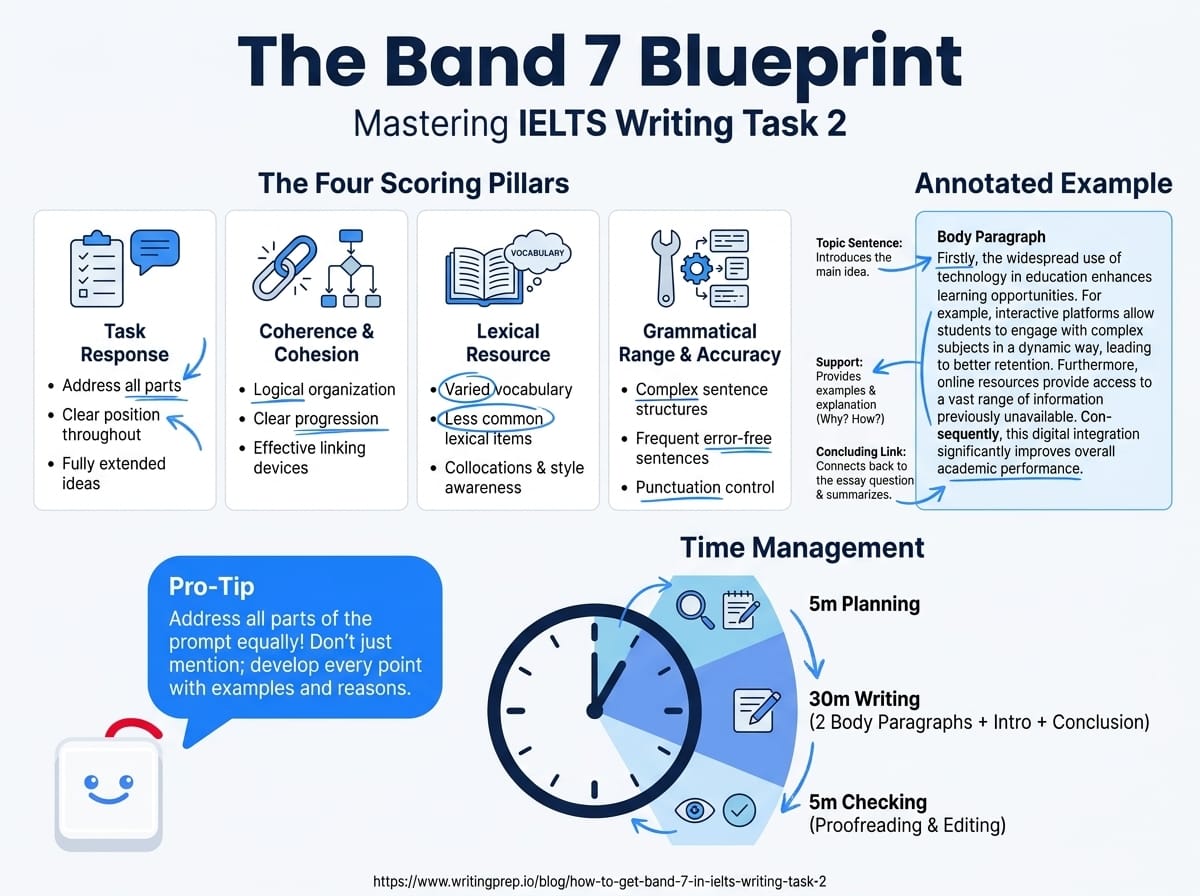
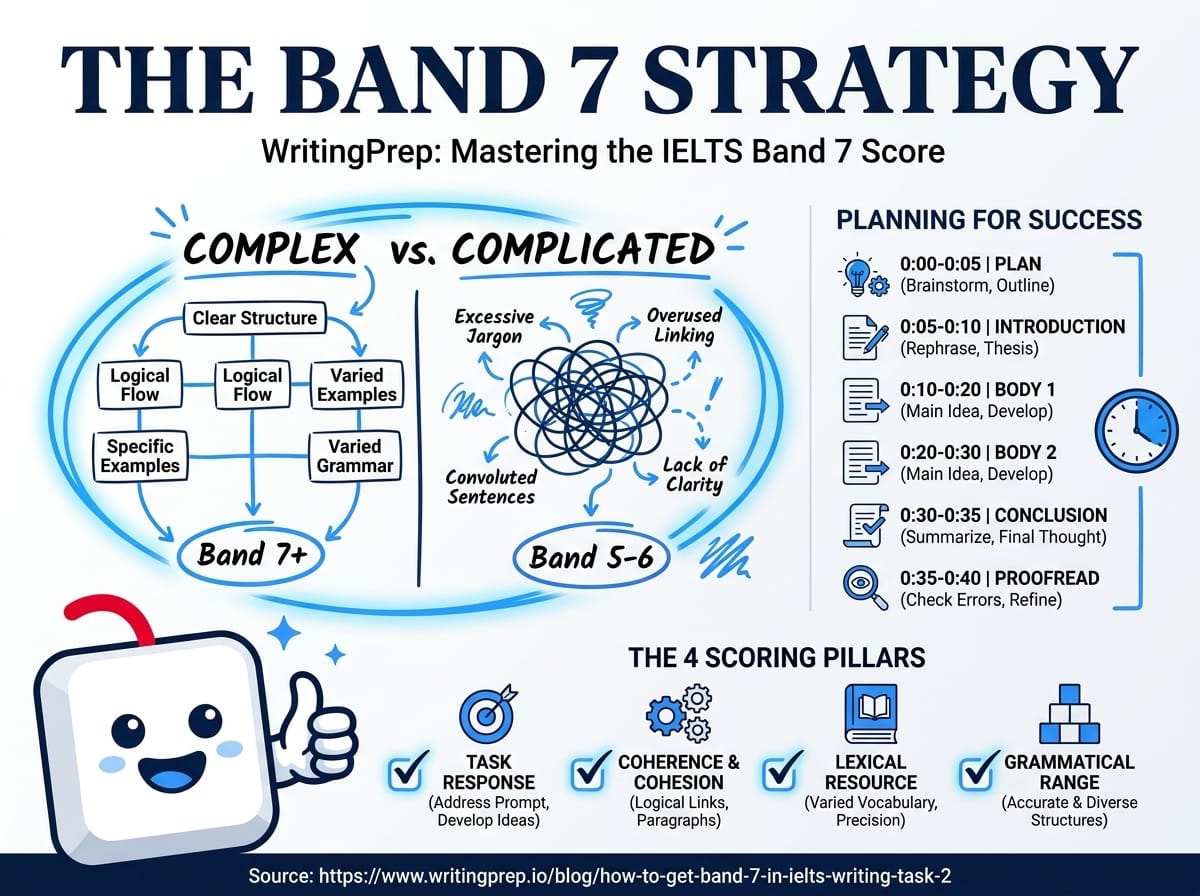
The Task 2 rubric scores you on four equally weighted criteria. Understanding each one at the Band 7 level removes the guesswork from your practice.
1. Task Response at Band 7
You must answer all parts of the question with a clear position. A Band 7 response presents a balanced argument, supports ideas with examples, and stays relevant throughout. You do not need a "perfect" opinion — you need a consistent one that directly addresses the prompt.
2. Coherence and Cohesion at Band 7
Ideas must flow logically from one to the next. You should use a range of linking words naturally (not mechanically), organise paragraphs around single clear points, and guide the reader through your reasoning. Overusing "Furthermore" and "Moreover" actually hurts you; clear paragraphing matters more than fancy connectors.
3. Lexical Resource at Band 7
You need a sufficient range of vocabulary to discuss the topic with some flexibility and precision. Occasional errors are acceptable at Band 7 as long as they do not block meaning. The key is using topic-specific words accurately rather than repeating safe, basic terms.
4. Grammatical Range and Accuracy at Band 7
A mix of simple and complex sentence structures is expected, with frequent error-free sentences. You do not need flawless grammar, but mistakes should be minor and rare enough not to distract the reader. Varied sentence openings and accurate tenses signal control to the examiner.
The 4 Mistakes That Cap Most Writers at Band 6
Before building your roadmap, audit whether these habits are holding you back:
- Answering the question you wished you got, not the one asked. A common Band 6 trap is writing a generic essay on the topic instead of responding to the specific instruction (agree/disagree, discuss both views, advantages/disadvantages, or problem/solution).
- Under-developing body paragraphs. A point with one thin sentence and no example reads as "inadequate" to examiners. Each body paragraph needs a claim, an explanation, and a concrete illustration.
- Memorised phrases that don't fit. "It is universally acknowledged that…" sounds robotic and often mismatches the context, dragging down both Coherence and Lexical scores.
- Never reviewing your own work. Writing ten essays without feedback builds the same mistakes ten times. Targeted correction — especially explanations of why something is wrong — is what actually produces a Band 7.
A Step-by-Step Roadmap to Band 7
Use this repeatable process for every Task 2 you practice. It mirrors how high-scoring candidates prepare.
Step 1: Decode the Question in 60 Seconds
Underline the instruction word (agree/disagree, etc.) and the two issues you must address. Decide your position before you write a single sentence. A clear thesis in your introduction anchors the entire essay.
Step 2: Build a 4-Paragraph Skeleton
Plan: (1) Introduction with position, (2) Body paragraph A with one developed point, (3) Body paragraph B with a second developed point or counter-argument, (4) Conclusion that restates the position. Spend two minutes outlining so your writing stays focused.
Step 3: Write With Band 7 Lexical Range
Replace vague words with precise ones — "good" becomes "beneficial" or "advantageous," "bad" becomes "detrimental" or "problematic." Use collocations you are confident about (e.g., "a pressing issue," "yield positive outcomes") rather than inventing complex phrases.
Step 4: Self-Edit Against the Descriptors
In your last three minutes, re-read for task completion, paragraph unity, and grammar slips. Check that every body paragraph has an example and that linking words connect ideas rather than just sitting at the start of sentences.
Step 5: Get Feedback That Explains, Not Just Corrects
Submit your essay to a tool that shows you why a sentence is weak, not only what to change. Explanations build the judgement you need on exam day — when no tutor is sitting beside you.
How WritingPrep Accelerates Your Band 7 Journey
WritingPrep is built specifically for the kind of feedback that moves Task 2 scores. Instead of a single red line, you receive structured, AI-powered guidance on the four marking criteria:
- Task Response checks confirm you have addressed every part of the prompt and kept a consistent position.
- Coherence feedback highlights where paragraphs wander or connectors feel forced, helping you tighten flow.
- Vocabulary analysis suggests more precise, academic alternatives without pushing words you don't understand.
- Grammar explanations teach the rule behind each correction, so the same error doesn't recur in your next essay.
Because feedback is instant and unlimited, you can practice the Step 1–5 roadmap daily and watch your weak areas shrink week by week. For a structured start, WritingPrep lets you submit a full Task 2 response and get criterion-level feedback in minutes.
Your Next Step Toward Band 7
Reaching Band 7 in IELTS Writing Task 2 is less about native-level English and more about writing on-topic, well-structured essays and fixing the same recurring errors. Decode the question, plan a clear skeleton, use precise vocabulary, and review every draft against the descriptors. Then let explained feedback do the heavy lifting.
Ready to find out what is standing between you and Band 7? Start Practicing with WritingPrep today and turn your next essay into your highest-scoring one yet.