IELTS Writing Task 1 for Beginners: Master Data Description for Band 7+
Embarking on your IELTS journey can feel overwhelming, especially when you face the IELTS Writing section. For many beginners, IELTS Writing Task 1 presents a unique challenge: describing visual information accurately and concisely within a strict 20-minute limit. This task requires more than just good English; it demands strategic data analysis, clear report organization, and precise vocabulary.
Whether you are preparing with our dedicated IELTS Writing Practice engine or tackling past exam prompts, this complete beginner's guide provides actionable IELTS Writing Task 1 tips to elevate your score to Band 7 and beyond. For essay strategies, also see our roadmap on IELTS Writing Task 2 Band 8 Structure.
Understanding IELTS Writing Task 1: What to Expect
IELTS Writing Task 1 requires you to describe, summarize, or explain information presented in a visual format. This could be a bar chart, line graph, pie chart, table, map, or process diagram. For IELTS Academic, you'll typically analyze data or a process. If you're taking IELTS General Training, Task 1 involves writing a letter. While this article focuses on the academic data description, the principles of clear writing and organization apply to both.
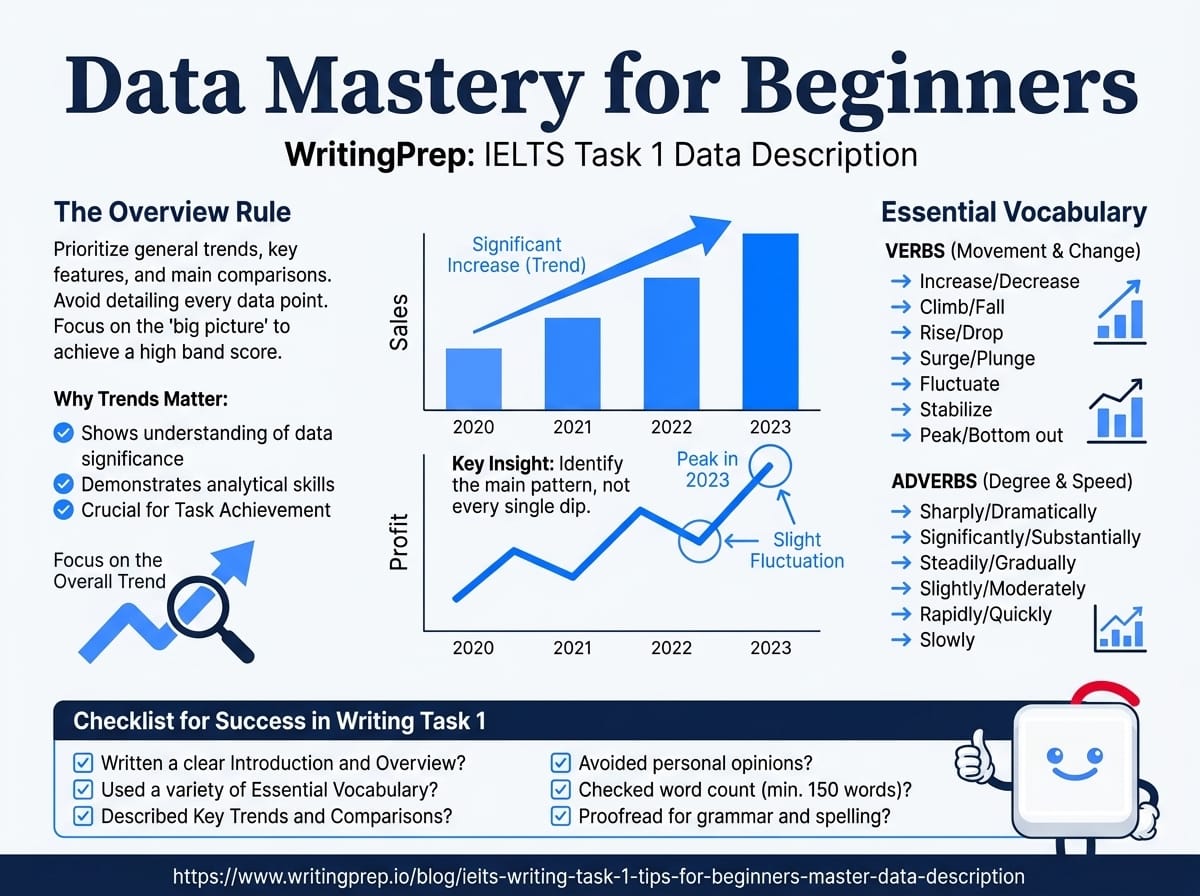
Your goal is not just to list every detail, but to identify the main features, trends, and comparisons, and present them in a coherent report of at least 150 words, all within 20 minutes.
Essential Strategies for Success in IELTS Writing Task 1
Mastering Task 1 involves a combination of analytical skills and strong writing proficiency. Here are crucial tips for beginners:
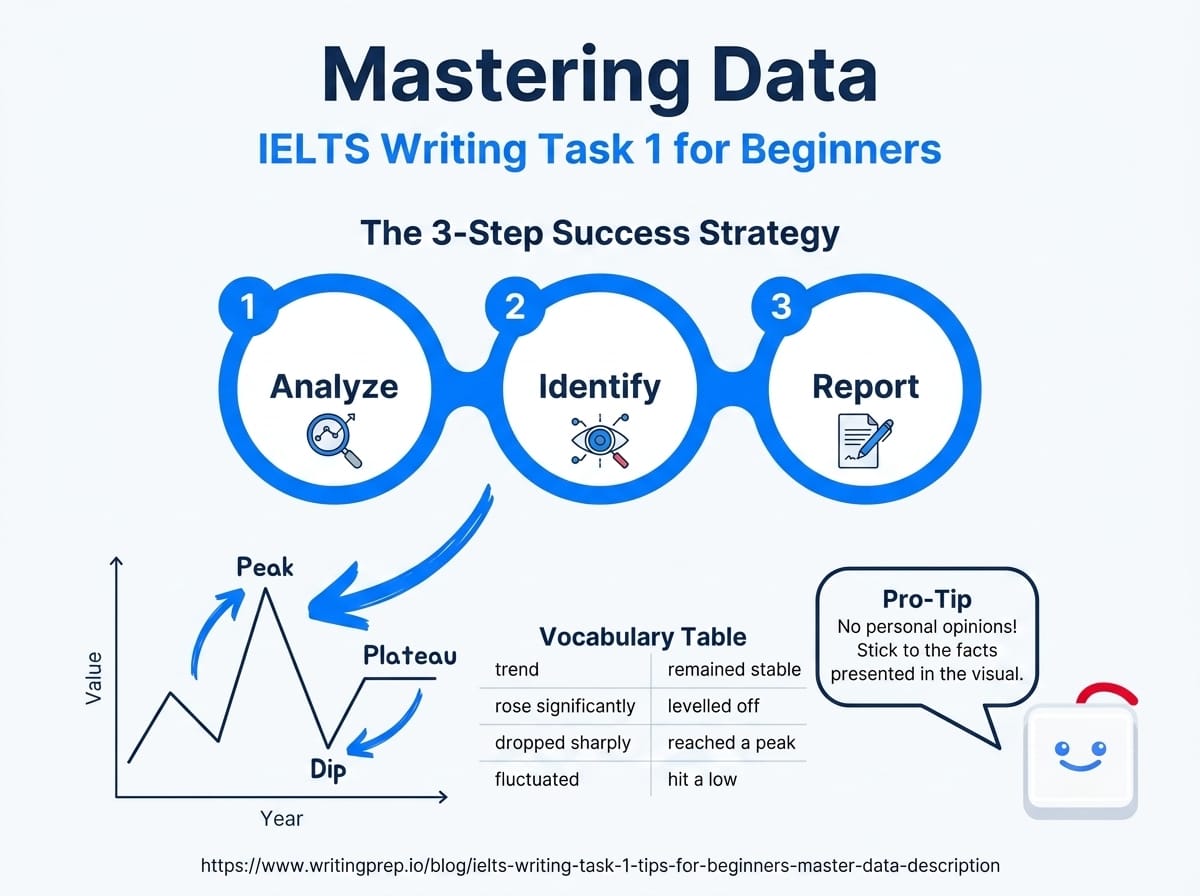
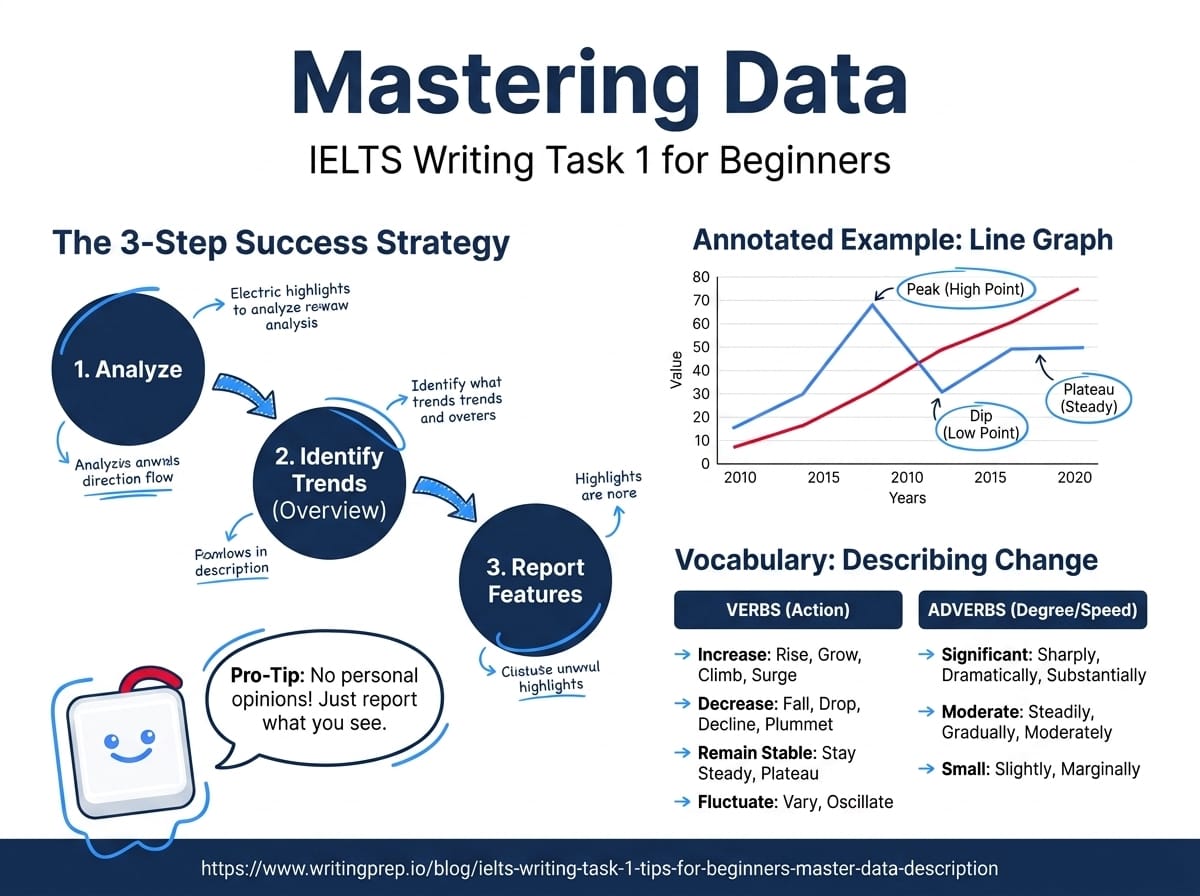
1. Deconstruct the Visual: Analyze and Identify Main Features
Before you even start writing, spend 2-3 minutes carefully analyzing the given visual.
- Understand the Context: What does the graph/chart represent? What are the axes? What are the units of measurement? What time period does it cover?
- Identify Main Trends: What are the most significant changes, increases, decreases, or stable periods? Are there any striking highs or lows?
- Make Comparisons: For multiple lines or bars, what are the most noticeable similarities or differences?
- Group Information: Don't try to describe everything point by point. Group related information to make your report clearer and more concise.
2. Structure Your Response for Clarity
A well-structured essay is key to achieving a high score for coherence and cohesion.
- Introduction (1-2 sentences): Paraphrase the prompt to introduce what the visual shows. Do not copy the prompt directly. This is a great place to practice your English vocabulary and paraphrasing skills.
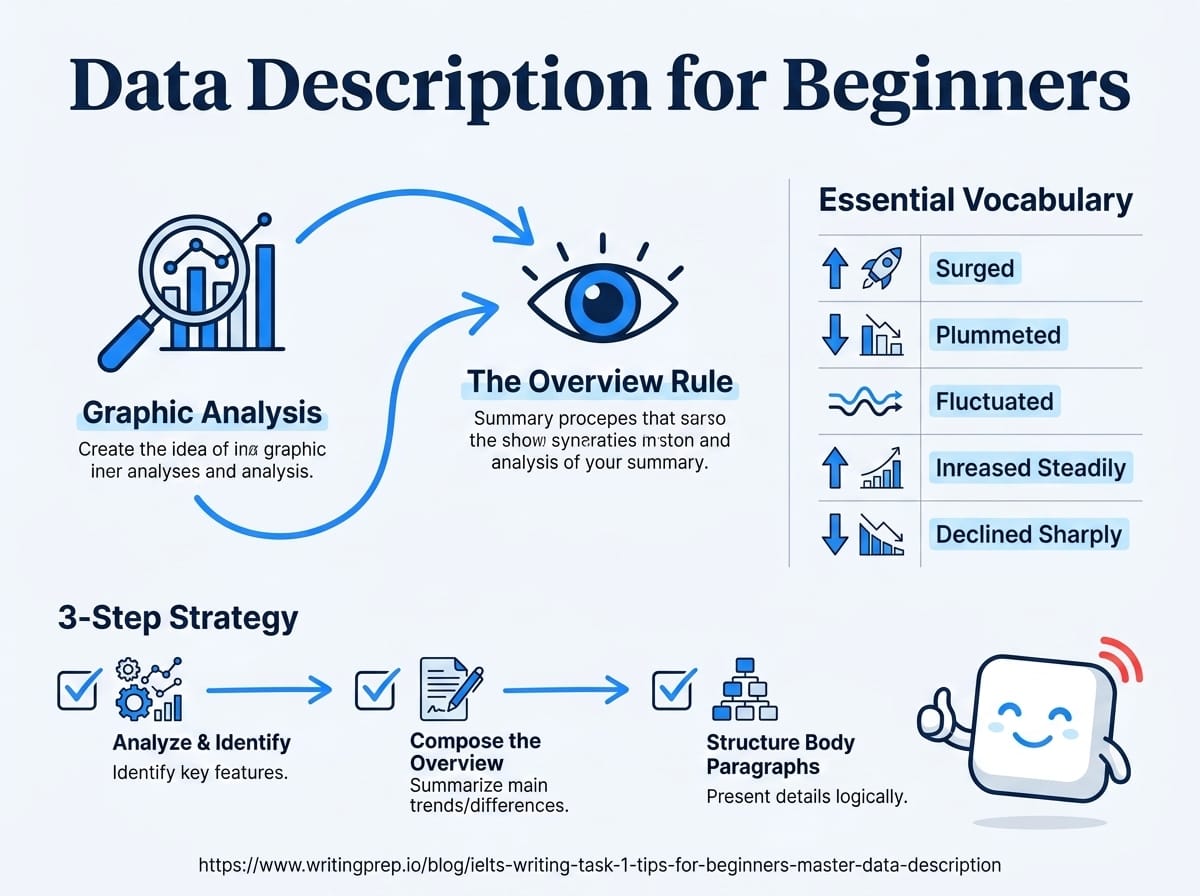
- Overview (2-3 sentences): This is CRUCIAL. Summarize the most significant overall trends or features without including specific data points. This demonstrates your ability to see the "big picture."
- Body Paragraphs (2-3 paragraphs): Detail the main features you identified, supporting them with specific data points. Dedicate separate paragraphs to distinct trends or comparisons. Use comparison language (e.g., whereas, in contrast, while) and precise language for trends (e.g., soared, plummeted, remained stable).
3. Master Language: Vocabulary and Grammar
Your language proficiency is assessed on IELTS Writing Task 1.
- IELTS Vocabulary: Use a range of appropriate vocabulary to describe trends (e.g., fluctuate, peak, trough, decline, ascend), proportions (e.g., a significant proportion, the majority, nearly half), and comparisons (e.g., significantly larger than, almost identical to). Avoid repetition.
- IELTS Grammar: Ensure you use a variety of grammatical structures correctly. This includes complex sentences, passive voice (when appropriate), and accurate tense usage (often past simple for historical data). Pay close attention to prepositions, articles, and subject-verb agreement.
Common Mistakes and How WritingPrep Helps You Avoid Them
Many beginners fall into common traps in IELTS Writing Task 1:
- Listing every data point: This leads to a low word count and poor coherence. Focus on significant trends.
- Not providing an overview: Without an overview, your report lacks a clear summary and often scores lower.
- Incorrect data interpretation: Misreading the graph or chart can lead to inaccurate descriptions.
- Grammatical errors and limited vocabulary: These directly impact your score.
This is where WritingPrep shines as an invaluable tool for your IELTS prep. Instead of just guessing what's wrong or relying on generic AI tools that might not understand IELTS specific requirements (unlike chatgpt for english learning which is general-purpose), WritingPrep offers targeted, personalized feedback.
With WritingPrep, you can:
- Practice with Real Tasks: Upload your IELTS Writing Task 1 responses (and even IELTS Writing Task 2 essays!) and get instant, detailed feedback.
- Get an Expert
English Essay Checker: WritingPrep evaluates your writing on criteria like Task Achievement, Coherence & Cohesion, Lexical Resource (IELTS vocabulary), and Grammatical Range & Accuracy (IELTS grammar), just like a human examiner. - Receive Actionable Feedback: It doesn't just correct mistakes; it explains why they are mistakes and how to improve. This includes suggestions for better vocabulary, clearer sentence structures, and more effective organization.
- Track Your Progress: See your improvement over time, helping you focus on your weaker areas.
- Simulate Test Conditions: Regular practice with timed responses can help you manage your time effectively for the actual exam. Think of it as having unlimited IELTS practice tests at your fingertips.
Whether you're looking to check ielts academic essays or refine your general writing skills, WritingPrep provides the structured support you need. It’s more than just an AI; it’s a personalized tutor guiding you towards mastery.
Beyond Task 1: Comprehensive IELTS Prep with WritingPrep
While this article focuses on Task 1, remember that WritingPrep supports your entire IELTS writing journey. From honing your argument for Task 2 to expanding your general english vocabulary and mastering complex grammatical structures, our platform is designed for holistic improvement. Forget expensive IELTS preparation books that offer generic advice; WritingPrep adapts to your learning needs.
Start Your Journey to a Higher IELTS Score Today!
Mastering IELTS Writing Task 1 is absolutely achievable with the right strategy and consistent practice. By understanding the task, planning your response, and focusing on clear, accurate language, you're well on your way to success.
Ready to put these tips into practice and elevate your writing? Explore more about how WritingPrep can transform your IELTS prep at WritingPrep.io. Or, better yet, start your free trial and receive instant, personalized feedback on your next essay. Begin your journey to writing excellence today at app.writingprep.io!