Mastering English Writing for Global Opportunities: IELTS vs. TOEFL iBT
For English learners worldwide, achieving proficiency in writing is often a gateway to academic and professional success. Whether you're an English learner aiming for higher education, an IELTS/TOEFL aspirant seeking to study abroad, or a scholarship hunter needing to demonstrate your command of English, the writing section of standardized tests like the International English Language Testing System (IELTS) and the Test of English as a Foreign Language (TOEFL iBT) presents unique challenges. Understanding the core differences in characteristics between these two prominent tests is crucial for effective preparation.
While both IELTS and TOEFL iBT assess your ability to write clearly, coherently, and accurately in English, their formats, task types, and assessment criteria vary significantly. This detailed comparison will illuminate these distinctions, guiding you toward a more focused and efficient preparation strategy.
Understanding the IELTS Writing Section
The IELTS writing section is designed to assess a wide range of writing skills, from describing data and processes to presenting well-developed arguments. It consists of two tasks, with specific requirements for both IELTS Academic and IELTS General Training modules.
IELTS Writing Task 1
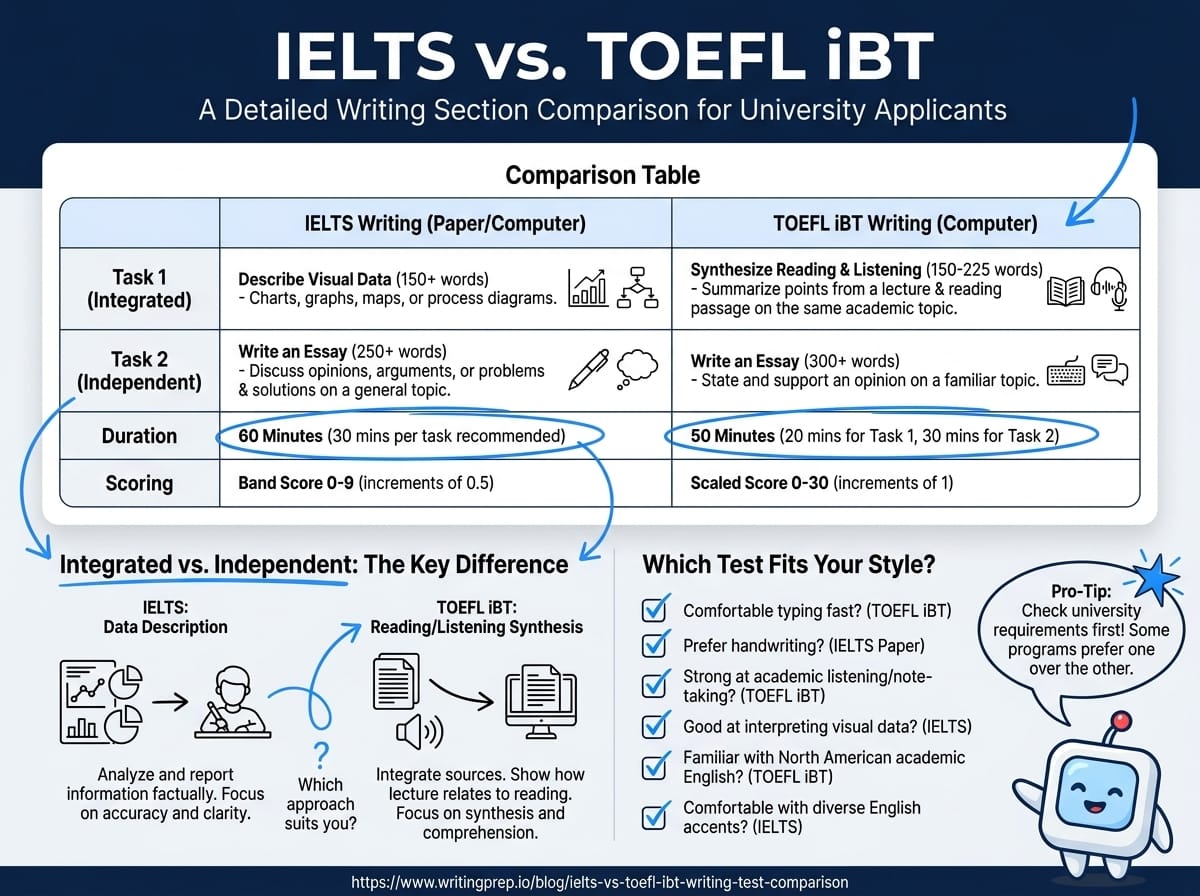
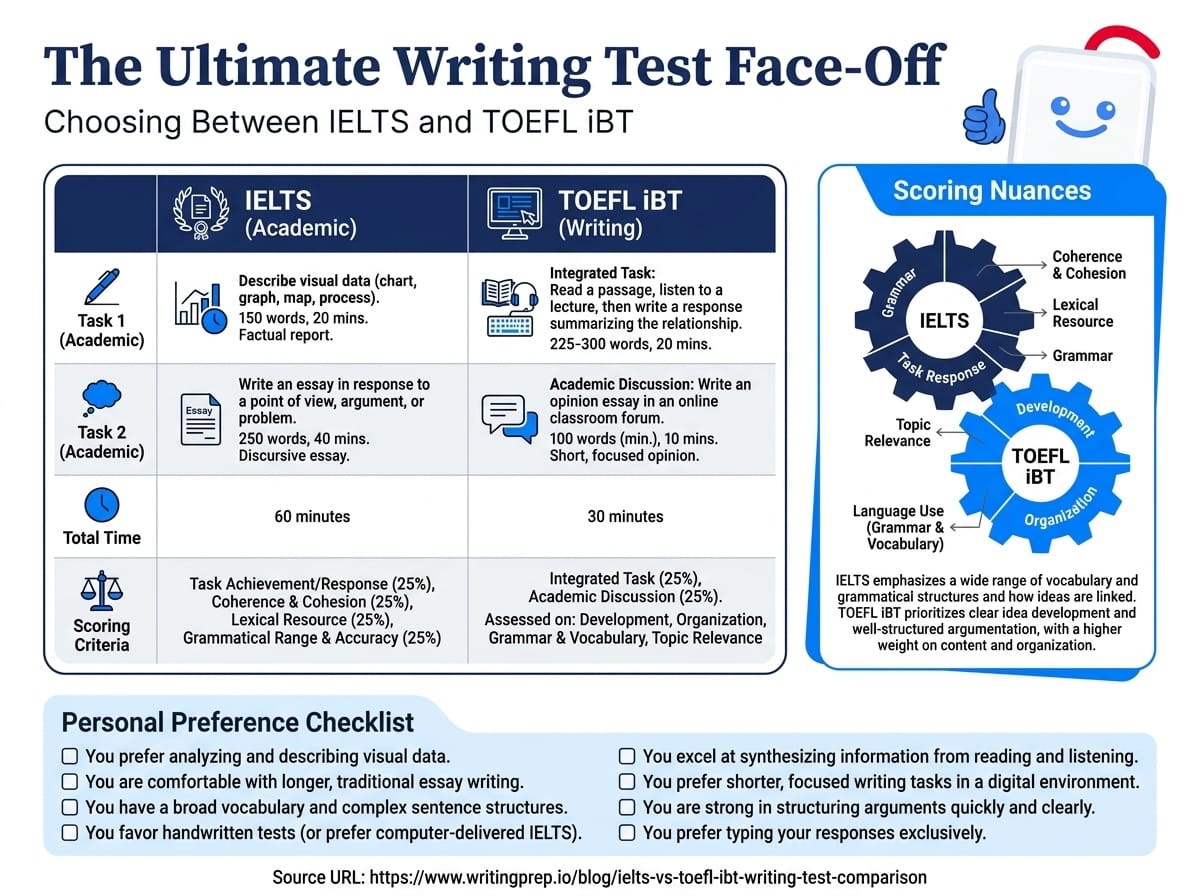
This task requires candidates to write a minimum of 150 words in approximately 20 minutes.
- IELTS Academic Writing Task 1: Candidates are presented with a graph, table, chart, or diagram and must describe, summarize, or explain the information in their own words. This often involves identifying key trends, comparing data, or explaining a process. Developing strong analytical and descriptive skills is vital here.
- IELTS General Training Writing Task 1: Candidates are given a situation and asked to write a letter requesting information or explaining a situation. The letter can be formal, semi-formal, or informal, requiring an understanding of appropriate tone and register.
IELTS Writing Task 2
This task, common to both Academic and General Training modules, requires candidates to write a minimum of 250 words in approximately 40 minutes.
- Candidates are presented with a point of view, an argument, or a problem, and must write an essay in response. This involves presenting and justifying an opinion, discussing a problem and potential solutions, or evaluating evidence and ideas. Strong argumentative and discursive skills are key.
Assessment Criteria for IELTS Writing:
IELTS writing is evaluated based on four criteria:
- Task Achievement/Response: How well you address all parts of the prompt.
- Coherence and Cohesion: The logical organization of your ideas and the effective use of linking devices.
- Lexical Resource: The range and accuracy of your
IELTS vocabulary. - Grammatical Range and Accuracy: The variety and correctness of your
IELTS grammar.
Effective IELTS prep involves extensive IELTS practice tests and familiarizing oneself with IELTS preparation books to master these criteria.
Understanding the TOEFL iBT Writing Section
The TOEFL iBT writing section is fully computer-based and assesses your ability to integrate information from reading and listening sources, as well as to express and support your ideas clearly. It also consists of two tasks.
TOEFL iBT Integrated Writing Task
This task takes approximately 20 minutes.
- Candidates first read a short academic passage (approximately 3 minutes).
- Then, they listen to a short lecture on the same topic (approximately 2 minutes).
- Finally, they write an essay (150-225 words) summarizing the main points of the lecture and explaining how they relate to the points in the reading passage. This task heavily emphasizes synthesis and summarization skills.
TOEFL iBT Academic Discussion Task (formerly Independent Writing)
This task takes approximately 10 minutes.
- Candidates read a brief discussion post from a professor and two student responses.
- They then write their own post (at least 100 words) expressing and supporting their opinion on the topic, contributing to the online discussion. This task assesses the ability to articulate and justify a personal viewpoint in a concise manner.
Assessment Criteria for TOEFL iBT Writing:
TOEFL writing practice focuses on:
- Development, Organization, and Cohesion: How well you develop your ideas, organize your essay, and connect your thoughts.
- Language Use: The range and accuracy of your
english vocabularyand grammar, including sentence structure and mechanics.
To succeed, candidates often utilize TOEFL writing templates and review TOEFL essay samples and TOEFL preparation books to understand the expected structure and quality.
Key Differences in Writing Sections: IELTS vs. TOEFL iBT
The choice between IELTS and TOEFL iBT often comes down to personal preference, familiarity with test formats, and specific institutional requirements. Here are the critical distinctions in their writing sections:
1. Task Types and Skills Assessed
- IELTS: Features distinct tasks – a report/letter and an essay. Task 1 (
ielts writing task 1) often tests descriptive or communicative skills, while Task 2 (ielts writing task 2) assesses argumentative or discursive writing. It's more about demonstrating different styles of writing. - TOEFL iBT: Emphasizes integrated skills. The Integrated Writing Task specifically tests your ability to synthesize information from multiple sources (reading and listening), a crucial skill for academic success. The Academic Discussion Task tests your ability to contribute to an online academic discussion.
2. Format and Delivery
- IELTS: Can be taken on paper or computer. You type or handwrite your responses.
- TOEFL iBT: Exclusively computer-based. All responses are typed.
3. Time Management and Word Count
- IELTS: Longer essays (250+ words for Task 2) with more time (40 mins). Task 1 (150+ words) with 20 mins. Total 60 minutes for two tasks.
- TOEFL iBT: Shorter essays (150-225 words for Integrated, 100+ for Academic Discussion) with less time per task (20 mins and 10 mins respectively). Total 30 minutes for two tasks.
4. Grading and Scoring
- IELTS: Scores are reported in bands from 0-9 for each skill, including writing. Assessors focus on the four criteria mentioned earlier.
- TOEFL iBT: Scores are reported from 0-30 for the writing section. Automated scoring (AI) and human raters are used, with a strong emphasis on development, organization, and language use.
5. Approach to Preparation
- IELTS: Requires mastering different writing genres (report, letter, essay) and developing strong analytical and argumentative skills.
IELTS general trainingcandidates will focus on letter writing, whileIELTS academiccandidates focus on data description. - TOEFL iBT: Requires significant
toefl writing practicein note-taking, summarizing, and synthesizing information quickly, alongside developing well-structured arguments.
How WritingPrep Empowers Your IELTS & TOEFL Writing Journey
Regardless of whether you choose IELTS or TOEFL iBT, mastering academic and general English writing requires consistent practice and targeted feedback. This is where WritingPrep becomes your ultimate AI-powered ally.
WritingPrep is an advanced english essay checker designed to provide personalized, actionable, and immediate feedback on your writing. Instead of just guessing what to improve, WritingPrep helps you understand how to refine your skills, making it an invaluable IELTS Prep App and TOEFL prep tool.
Tailored Feedback for Both Exams:
- Comprehensive Evaluations: Receive detailed feedback on
ielts grammar,ielts vocabulary, sentence structure, coherence, clarity, and overall writing quality. This is crucial for bothIELTS writing task 1andIELTS writing task 2, as well astoefl writing practice. - Grammar and Vocabulary Enhancement: WritingPrep doesn't just correct mistakes; it explains them. Improve your
english vocabularyand grammatical range, essential for achieving high scores in both tests. Our platform helps you expand yourielts vocabularyand use complexielts grammaraccurately. - Coherence and Cohesion Analysis: For IELTS, we help ensure your ideas flow logically. For TOEFL's integrated task, we assist in structuring synthesized information effectively.
- Structure and Organization: Get guidance on essay structure, paragraphing, and how to develop your arguments clearly, whether you're working on
toefl writing templatesor refining yourielts essay. - Practice and Revision: Upload your essays and receive instant feedback, allowing for continuous revision and improvement. This is far more efficient than waiting for human feedback or relying on generic tools.
While tools like ChatGPT for English learning can offer general assistance, WritingPrep provides focused, structured feedback specifically designed to meet the rigorous demands of IELTS and TOEFL iBT assessments. It's like having a personal tutor available 24/7, guiding you through IELTS practice tests and TOEFL practice test scenarios. Our system can help you check ielts academic essays with precision, ensuring you meet the stringent requirements of the test.
Conclusion: Choose Your Path, Master Your Writing
The decision between IELTS and TOEFL iBT should be an informed one, based on your strengths, learning style, and specific goals. Both tests are globally recognized, but their writing sections demand different approaches. Understanding these differences is the first step towards effective preparation.
No matter which test you choose, consistent English writing practice and high-quality feedback are non-negotiable for success. WritingPrep is here to bridge that gap, providing an accessible, affordable, and scalable solution for all your IELTS and TOEFL writing needs. Stop guessing and start improving with personalized insights.
Ready to elevate your English writing skills and conquer your exam? Learn more about WritingPrep and Start practicing now to experience the future of personalized writing feedback!