Why Most Writing Preparation Fails: The Passive Learning Trap
For millions of candidates preparing for IELTS, TOEFL iBT, the Duolingo English Test (DET), or graduate academic coursework, writing preparation often feels like the most frustrating part of the journey.
Many test-takers invest dozens of hours reading model essays, memorizing lists of advanced vocabulary, and watching YouTube strategy videos. Yet, when sitting in front of a blank screen under a ticking countdown clock, they freeze. Their essays suffer from disjointed structure, repetitive phrasing, unfinished paragraphs, and recurring grammatical slips.
Why does this happen? Because passive consumption does not build active writing stamina.
Effective writing preparation is not an academic study session—it is athletic conditioning for your cognitive and lexical faculties. Just as you cannot run a marathon by solely watching running tutorials, you cannot produce a high-scoring 250-word IELTS essay or a concise 130-word TOEFL Academic Discussion response without structured, feedback-driven writing drills.
In this definitive writing preparation guide, we break down the 4-pillar preparation system, outline a realistic 30-day training roadmap, and share practical diagnostic frameworks to guarantee noticeable score improvements.
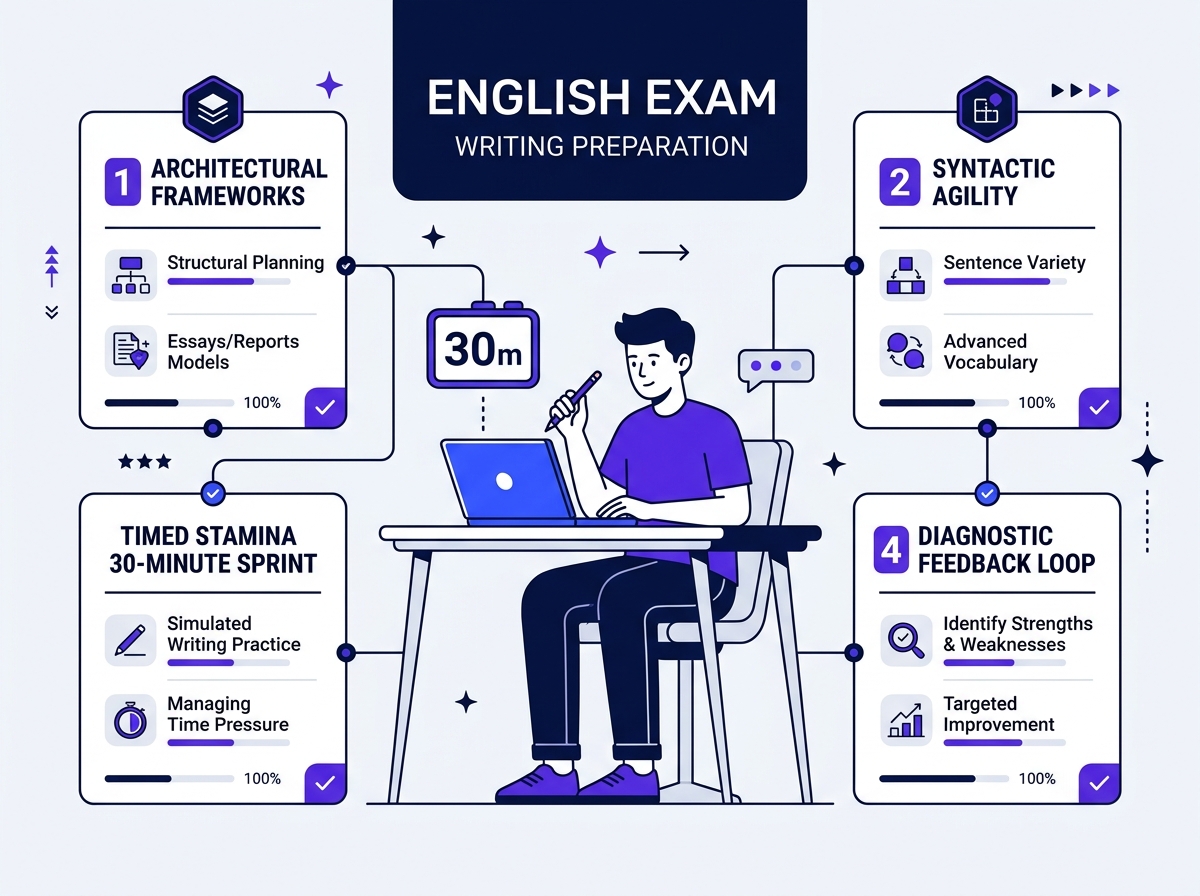
The 4 Pillars of High-Impact Writing Preparation
To progress from intermediate bands (IELTS 5.5–6.0 / TOEFL 17–20) to advanced proficiency (IELTS 7.5–8.5 / TOEFL 26–30), your writing preparation must target four distinct competencies:
┌─────────────────────────────────────────────────────────────┐
│             THE 4 PILLARS OF WRITING PREPARATION            │
├───────────────┬───────────────┬───────────────┬─────────────┤
│   PILLAR 1    │   PILLAR 2    │   PILLAR 3    │  PILLAR 4   │
│ Architectural │ Syntactic &   │ Timed Stamina │ Diagnostic  │
│  Frameworks   │ Lexical Agility│ & Execution  │  Feedback   │
└───────────────┴───────────────┴───────────────┴─────────────┘
Pillar 1: Architectural Frameworks (Structure Before Words)
Examiners in both IELTS and TOEFL evaluate structural coherence first. If your essay's logical progression is chaotic, sophisticated vocabulary cannot rescue your score.
- Paragraph Boundaries: Every paragraph must serve exactly one central communicative function (introduction, claim + justification, concession, or conclusion).
- Signposting & Transitionals: Connect ideas using explicit relational markers (conversely, consequently, in light of this, furthermore).
- Pre-Emptive Outlining: Never type sentence one without a 90-second mental or written bullet outline.
Pillar 2: Syntactic & Lexical Agility
A high score requires demonstrating command of varied sentence patterns without sacrificing grammatical accuracy:
- Avoid overusing simple subject-verb-object structures.
- Integrate complex sentences using adverbial clauses ("Although public transportation requires substantial initial subsidies, its long-term economic dividends outweigh upfront capital costs.").
- Deploy nominalization and passive constructions where formal objective tone is rewarded.
Pillar 3: Timed Stamina & Execution Speed
Writing an exquisite essay in 60 minutes is useless if your exam limits you to 10, 20, or 30 minutes. Timed drills train your brain to retrieve vocabulary and organize paragraphs automatically, eliminating exam-day paralysis.
Pillar 4: Diagnostic Feedback Loops
The biggest obstacle in self-directed writing preparation is error blindness. When you proofread your own draft, your brain reads what you intended to write rather than what is actually on the screen. Regular, objective feedback—identifying subject-verb mismatches, article omissions, and weak transitions—is non-negotiable.
The 30-Minute Daily Writing Preparation Routine
You do not need four hours of free time every day to achieve dramatic improvements. Consistent, focused 30-minute deliberate practice sessions outperform marathon weekend cramming.
Here is the daily blueprint used by top-scoring students on WritingPrep:
| Phase | Duration | Focus Area | Action Steps |
|---|---|---|---|
| Phase 1: Prompt Analysis & Outline | 5 Minutes | Deconstruction | Identify the core prompt question, determine your stance, and jot down two distinct supporting arguments with micro-examples. |
| Phase 2: Timed Sprint | 15 Minutes | Execution | Draft the response continuously without stopping to self-correct minor spelling. Focus on argument progression and paragraph cohesion. |
| Phase 3: Proofreading Audit | 3 Minutes | Precision Polish | Systematically check for known weaknesses: verb tenses, singular/plural agreements, and comma splices. |
| Phase 4: Feedback & Diagnostic Review | 7 Minutes | Feedback Analysis | Run the essay through an automated scoring tool or AI evaluator to identify lexical gaps and coherence blind spots. Log errors in an Error Journal. |
Test-Specific Writing Preparation Strategies
While core writing fundamentals apply universally, each major standardized test demands tailored adjustments during your writing preparation cycle.
1. TOEFL iBT Writing Preparation
The TOEFL iBT writing section consists of two distinct challenges:
- Integrated Writing Task (20 minutes): Requires summarizing a lecture that challenges or refutes points from a reading passage. Your preparation must emphasize synthesis verbs (counter, contend, refute, illustrate) and objective comparative structures.
- Writing for an Academic Discussion (10 minutes): Requires entering an ongoing academic exchange between a professor and two classmates. Speed and concise argument extension are paramount.
- Recommended Resource: Explore our complete guide on TOEFL Writing Academic Discussion Templates & Tips and benchmark your word targets with our TOEFL Word Count Strategy Guide.
2. IELTS Academic Writing Preparation
IELTS evaluates essays against four strict descriptors (Task Achievement, Coherence & Cohesion, Lexical Resource, and Grammatical Range & Accuracy):
- Task 1 (20 minutes / 150 words): Visual data reporting (bar charts, line graphs, process diagrams, maps). Practice identifying the overall trend first before detailing key features.
- Task 2 (40 minutes / 250 words): Discursive essay. Success requires balanced argumentation, concrete examples, and nuanced positioning.
- Recommended Resource: Learn how to avoid band penalties with Why Students Lose Marks in IELTS Writing.
3. Duolingo English Test (DET) Writing Preparation
The DET demands lightning-fast typing and spontaneous thought formulation under ultra-short timers (e.g., Write About the Photo for 1 minute, Interactive Writing for 5 minutes). Focus your preparation on rapid typing accuracy and immediate topic-sentence generation.
- Recommended Resource: Compare test dynamics in Duolingo English Test vs. IELTS & TOEFL Writing.
5 Essential Writing Preparation Rules to Boost Your Score
Rule 1: Build an Active "Error Journal"
Do not simply read corrections and nod in agreement. Create a dedicated notebook or digital doc divided into three columns:
- The Error: The original sentence with the mistake highlighted.
- The Correction: The grammatically precise revision.
- The Underlying Rule: The reason why the revision works (e.g., "Uncountable nouns like 'information' do not take plural -s").
Review your Error Journal for five minutes prior to every new practice session.
Rule 2: Practice "Micro-Drilling" Instead of Full Essays
If you struggle with introductions, do not write twenty complete essays. Instead, take ten different essay prompts and write only the introduction and thesis statement for each within 25 minutes. If your issue is paragraph development, spend 30 minutes writing three standalone body paragraphs with concrete real-world evidence.
Rule 3: Upgrade Common Vocabulary to Academic Collocations
Low-scoring essays repeat simplistic words like good, bad, a lot of, big problem. High-scoring candidates use academic collocations:
- Instead of "pollution is a big problem", write: "environmental degradation poses an existential challenge".
- Instead of "this shows that", write: "this empirical observation substantiates the hypothesis that".
- Instead of "people have different ideas", write: "public consensus regarding this policy remains deeply divided".
Rule 4: Master the Art of Concession
One-sided essays sound simplistic. Adding a concession clause demonstrates critical thinking and mature academic voice:
"While critics reasonably argue that remote schooling reduces spontaneous social interaction, these drawbacks are largely mitigated by structured collaborative digital platforms."
Rule 5: Simulate Authentic Exam Environments
Never practice writing in a quiet, leisurely environment with spellcheck enabled. Turn off browser autocorrect, set a visible digital timer, and practice on a standard desktop keyboard. Replicating the sensory conditions of test day reduces cognitive fatigue and anxiety on the actual exam.
Accelerate Your Writing Preparation with WritingPrep
The fastest way to plateau in your writing preparation is practicing in an echo chamber without objective measurement. Traditional tutors often take days to return marked essays, breaking the immediate feedback loop necessary for rapid neuroplastic learning.
With WritingPrep, you can:
- Practice authentic timed prompts for TOEFL iBT Academic Discussion, IELTS Task 1 & 2, and DET Writing.
- Receive instant, comprehensive rubrics analyzing your task fulfillment, grammatical accuracy, lexical variety, and coherence.
- Identify recurring syntax blind spots before test day.
Start integrating deliberate, timed practice into your routine today and transform your writing preparation into confident exam-day execution.