Hey there, future IELTS champ! Are you just starting your IELTS prep journey and feeling a bit overwhelmed by the IELTS Writing Task 1? You're not alone! This task, where you describe charts, graphs, maps, or processes, can seem tricky at first. But don't worry, with the right approach and a little practice, you can absolutely ace it.
This guide is specifically designed for beginners like you, offering clear, actionable IELTS Writing Task 1 tips to help you understand the task, structure your response effectively, and boost your overall IELTS writing score. Let's dive in!
Understanding IELTS Writing Task 1
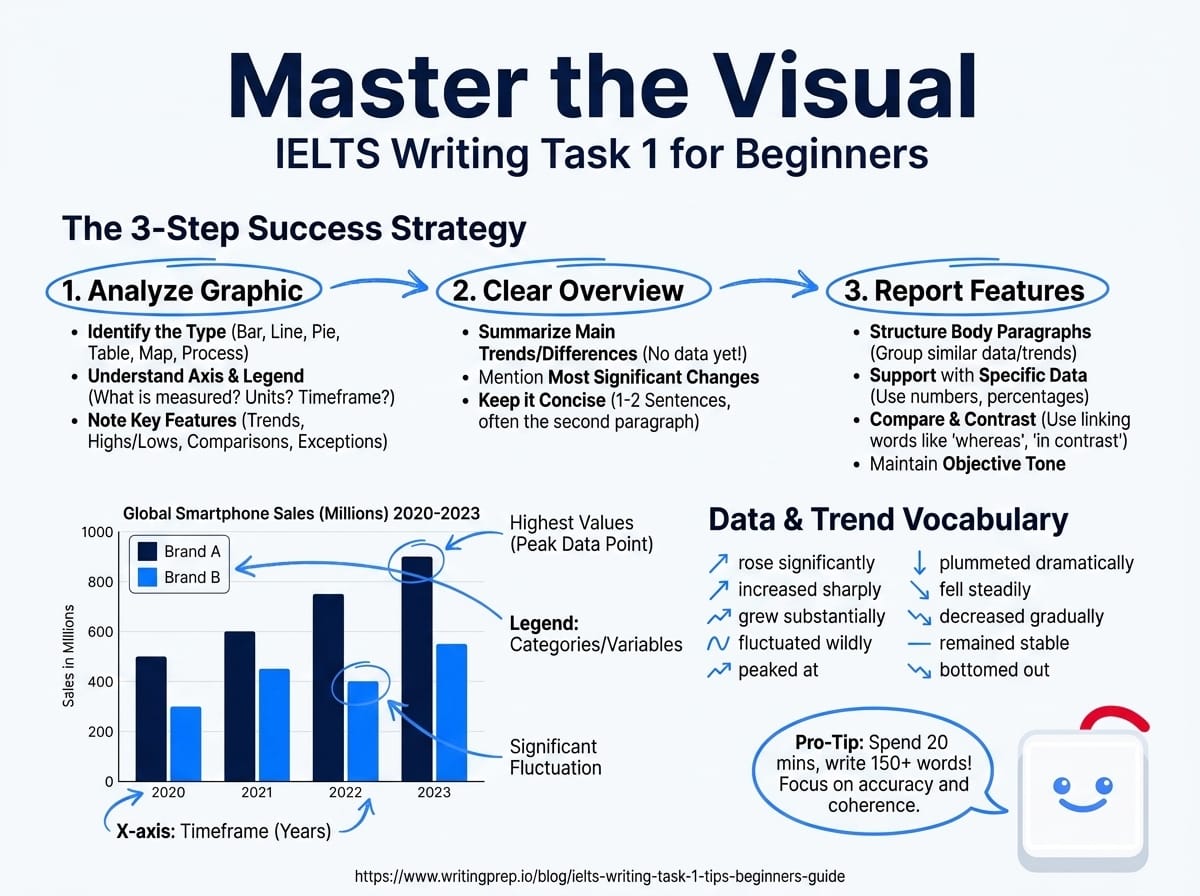
Before we get to the tips, let’s quickly recap what IELTS Writing Task 1 is all about. You'll be presented with some visual information – it could be a bar chart, line graph, pie chart, table, map, or a diagram illustrating a process. Your job is to describe this information in your own words, highlighting the main features and making relevant comparisons, all within a minimum of 150 words and ideally completed within 20 minutes.
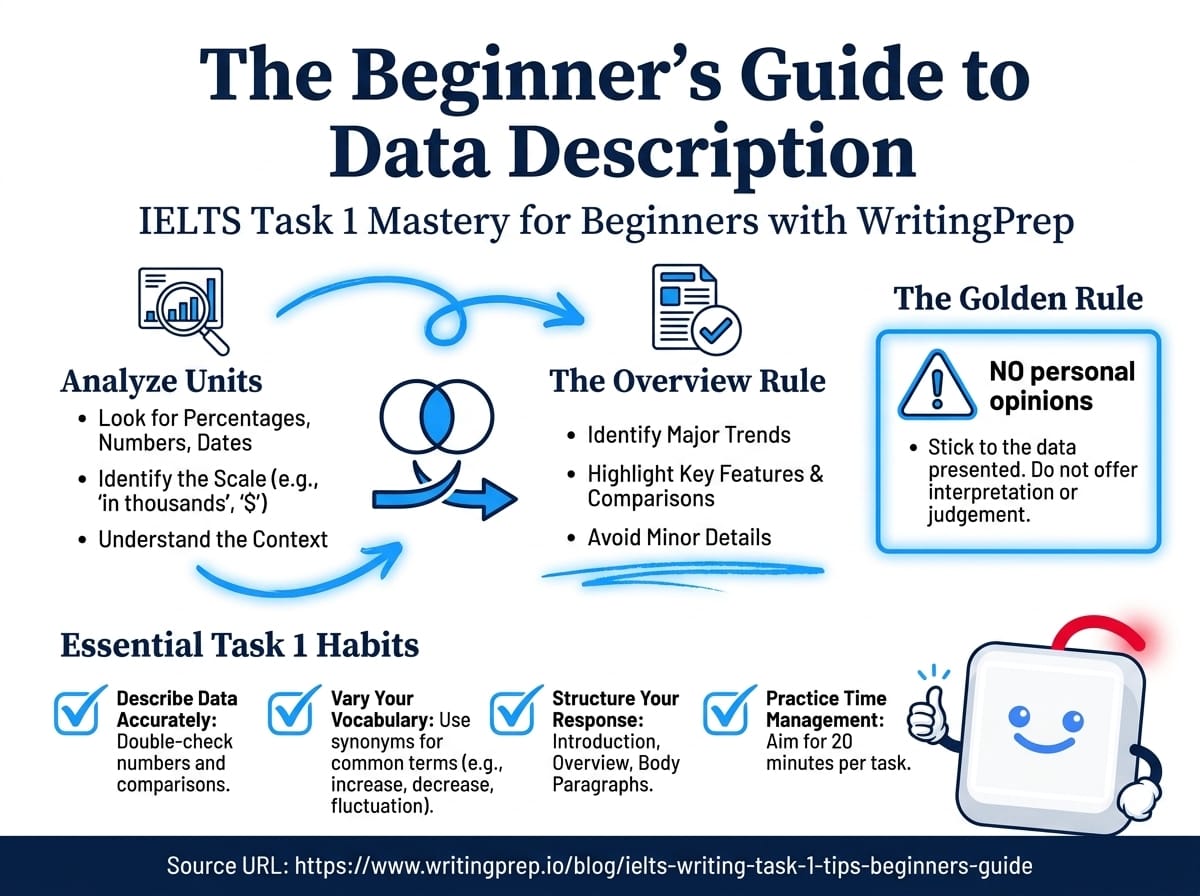
The key here isn't to explain why the data looks the way it does, but what the data shows. This is where your ability to summarize and report accurately comes into play.
Essential Tips for Boosting Your Task 1 Score
Ready to make your IELTS writing shine? Here are some crucial tips to get you started:
Tip 1: Analyze the Question and Visual Carefully
Before you even think about writing, spend a minute or two understanding the task.
- What is the visual showing? (e.g., population changes over time, sales figures, a manufacturing process).
- What are the labels? (axes, legend, dates, units of measurement).
- What are the main trends or features? Look for the highest, lowest, most significant changes, or key stages in a process. Don't try to describe every single detail; focus on the most important information.
Tip 2: Plan Your Report Structure
A well-structured report is key to a good score. Aim for four clear paragraphs:
- Introduction: Paraphrase the question to introduce what the visual shows. Don't copy the question directly!
- Example: "The bar chart illustrates the percentage of people who used public transport in four different cities between 2000 and 2010."
- Overview Paragraph: This is super important! Summarize the most striking general trends or features without including specific data. This paragraph acts as your conclusion and should clearly state the main message of the visual.
- Example: "Overall, it is clear that public transport usage increased in most cities over the period, with City A consistently showing the highest figures."
- Body Paragraph 1: Focus on a specific aspect or a set of related trends. Support your statements with specific data from the visual.
- Body Paragraph 2: Continue with other significant details, making comparisons where relevant. Ensure you refer back to the data.
Remember, clarity and coherence are crucial for both IELTS Writing Task 1 and IELTS Writing Task 2.
Tip 3: Expand Your Vocabulary and Master Key Grammar
To achieve a higher score, you need to demonstrate a range of IELTS vocabulary and IELTS grammar.
- Vocabulary for Trends: Learn synonyms for "increase," "decrease," "remain stable," "fluctuate," "peak," "plummet." Use adverbs to describe the speed or extent of change (e.g., "dramatically," "gradually," "sharply").
- Vocabulary for Comparisons: Words like "whereas," "while," "compared to," "in contrast," "significantly," "marginally."
- Grammar for Data Description: Practice using the passive voice (e.g., "Sales were recorded at 100 units"), various tenses (past simple for historical data, present simple for processes), and complex sentences to show relationships between data points.
Avoid repeating the same words and phrases. A rich english vocabulary will make your writing more engaging and sophisticated.
Tip 4: Practice, Practice, Practice!
Just like any skill, improving your IELTS writing takes consistent practice.
- Work through various IELTS practice tests specifically for Task 1.
- Time yourself to get used to the 20-minute limit.
- After writing, try to check IELTS Academic criteria yourself: Did you answer the question fully? Is your structure clear? Are there any IELTS grammar or spelling mistakes?
How WritingPrep Boosts Your IELTS Writing Success
Feeling ready to put these tips into action? This is where WritingPrep comes in! Our AI-powered platform is designed to be your ultimate IELTS Prep App, offering personalized feedback that goes beyond simple corrections.
Whether you're practicing for IELTS General Training or IELTS Academic, WritingPrep acts as your personal english essay checker. Here's how it helps:
- Detailed Feedback: Get immediate, actionable insights on your grammar, IELTS vocabulary usage, coherence, and task achievement for your IELTS writing task 1 responses.
- Grammar & Clarity: Our platform identifies common IELTS grammar mistakes and suggests improvements for clearer expression.
- Vocabulary Enrichment: Receive suggestions to enhance your english vocabulary, helping you use more precise and varied language.
- Structured Improvement: Unlike a general tool like ChatGPT for English learning, WritingPrep focuses specifically on the criteria needed for high scores in exams like IELTS and TOEFL, guiding you to understand how to improve.
- Mock Exam Practice: Submit your mock IELTS writing task 1 (and IELTS writing task 2) responses and get detailed evaluations, just like a real examiner would provide.
Ready to Ace Your IELTS Writing?
Don't let IELTS Writing Task 1 intimidate you. With these tips and the smart support of WritingPrep, you're well on your way to achieving your target score.
Ready to transform your IELTS writing skills? Learn more about WritingPrep and start getting personalized feedback today! Begin your practice now and experience the difference. Happy writing!