Mastering Coherence and Cohesion in IELTS Writing: Your Guide to Higher Scores
The IELTS Writing section is often considered one of the most challenging components of the exam. Beyond grammar and vocabulary, two critical aspects that significantly impact your score are coherence and cohesion. Many English learners struggle to weave their ideas together seamlessly, resulting in essays that, while grammatically correct, lack flow and clarity. If you're aiming for a high band score in IELTS writing, understanding and applying these principles is non-negotiable.
This guide will demystify coherence and cohesion, provide actionable strategies, and show you how to apply them effectively in both IELTS Writing Task 1 and IELTS Writing Task 2.
What Are Coherence and Cohesion?
While often used interchangeably, coherence and cohesion have distinct roles:
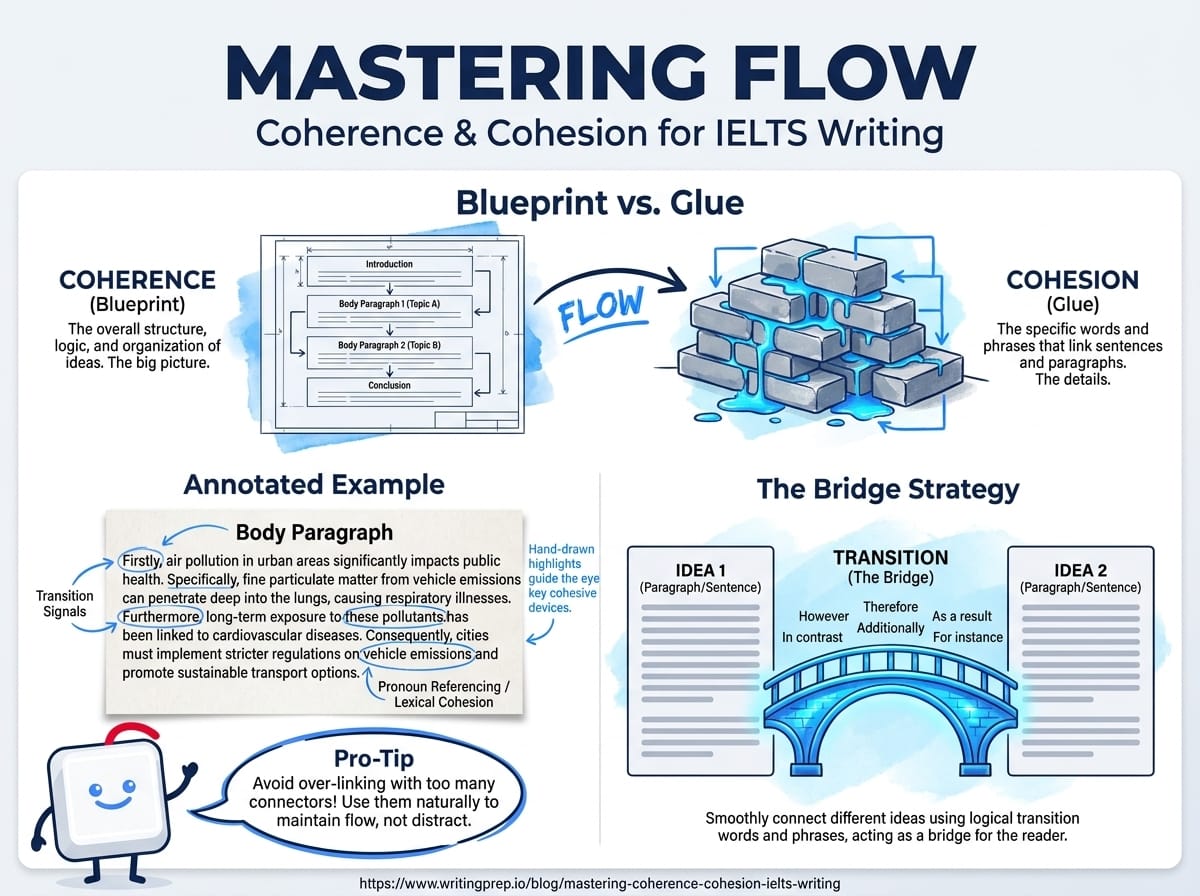
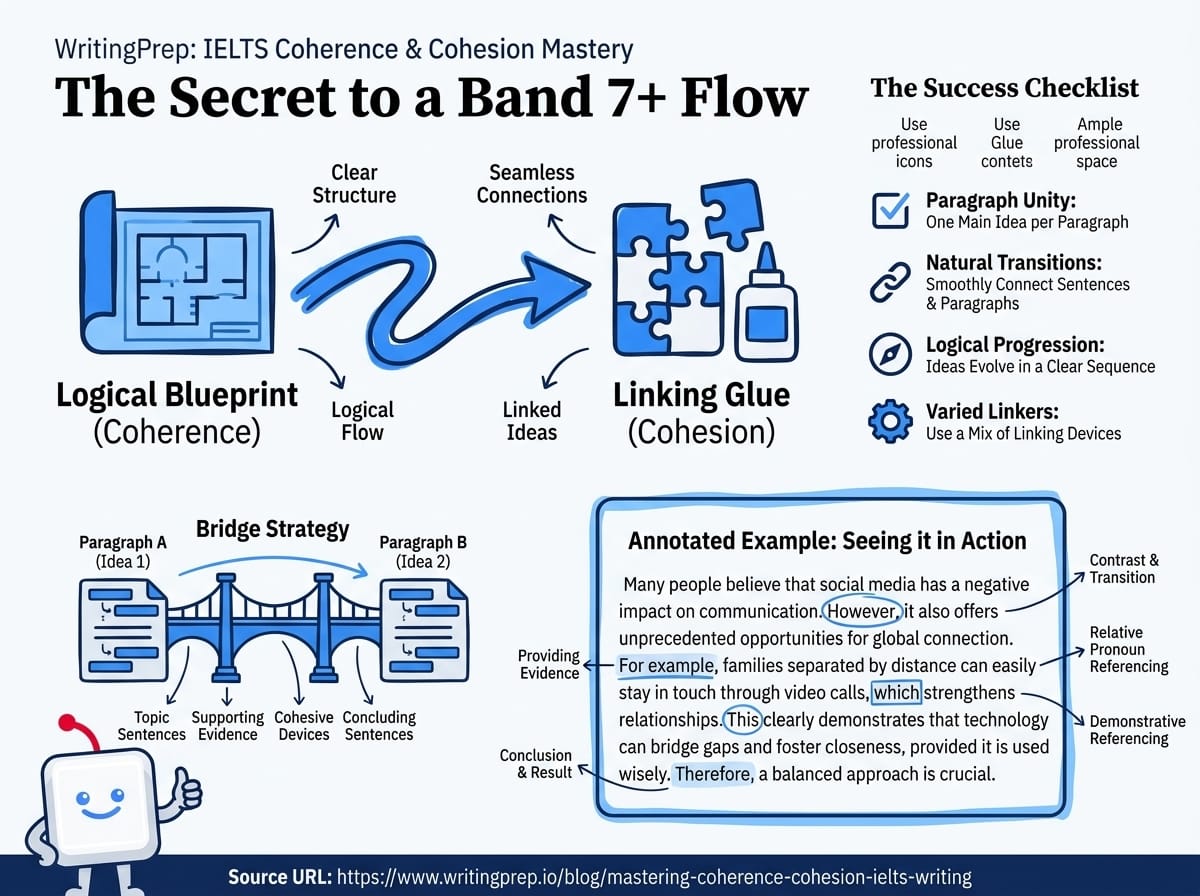
- Coherence: Refers to the logical organization of your ideas. A coherent essay presents ideas in a clear, sensible order, making it easy for the reader to follow your argument or explanation. It's about the "big picture" — how well all your points connect to the main topic and thesis.
- Cohesion: Deals with the grammatical and lexical links between sentences and paragraphs. It's about the "small picture" — using specific words and phrases (like transition words, pronouns, and synonyms) to create smooth connections between ideas.
Essentially, coherence is about the meaning and logic, while cohesion is about the language that binds that meaning together. You need both for a high-scoring essay.
Strategies for Enhancing Coherence
To make your IELTS writing coherent, focus on the following:
1. Plan Your Essay Meticulously
Before you start writing, spend a few minutes outlining your essay.
- For Task 2: Clearly define your thesis statement and brainstorm main ideas for each body paragraph. Ensure each paragraph supports your overall argument.
- For Task 1: Identify the main trends, comparisons, or stages you will describe and decide on a logical order for presenting them.
2. Craft Clear Topic Sentences
Each body paragraph should begin with a topic sentence that clearly states the main idea of that paragraph. This acts as a mini-thesis for the paragraph, guiding the reader and ensuring all subsequent sentences relate directly to it.
3. Develop Ideas Logically
Within each paragraph, ensure your supporting details, examples, and explanations flow logically from the topic sentence. Avoid introducing new, unrelated ideas mid-paragraph.
Strategies for Strengthening Cohesion
Cohesion is achieved through specific linguistic devices that link sentences and paragraphs:
1. Use Transition Words and Phrases
These are the glue that holds your essay together. Examples include:
- Adding information: Furthermore, moreover, in addition, additionally.
- Showing contrast: However, nevertheless, in contrast, on the other hand.
- Indicating cause/effect: Therefore, consequently, as a result, thus.
- Providing examples: For instance, for example, such as.
- Sequencing: Firstly, secondly, subsequently, finally.
- Summarizing: In conclusion, to sum up, overall.
Example: "Online learning offers great flexibility. However, it requires significant self-discipline."
2. Employ Pronoun Reference Effectively
Use pronouns (he, she, it, they, this, these) to refer back to previously mentioned nouns, avoiding repetitive noun usage. Ensure clarity in what each pronoun refers to.
Example: "Many students struggle with academic writing. They often find it difficult to structure their arguments."
3. Utilize Repetition and Synonyms (Lexical Chains)
While direct repetition should be used sparingly, repeating key terms or using synonyms and related vocabulary can create a strong thematic link throughout your essay. This creates a "lexical chain" that reinforces your main ideas.
Example: "The rise of artificial intelligence has transformed industries. This technological advancement presents both opportunities and challenges." (AI, technological advancement)
Applying Coherence and Cohesion in IELTS Writing Tasks
IELTS Writing Task 1: Report Writing
In Task 1, whether describing a graph, chart, map, or process, coherence means presenting information in a logical order (e.g., chronological, by significance, by category). Cohesion means using linking words to compare data, show trends, or describe steps. For example, "The sales of Product A increased significantly, while in contrast, Product B saw a slight decline."
IELTS Writing Task 2: Essay Writing
For Task 2, coherence is about developing a clear argument with well-structured paragraphs, each contributing to your overall thesis. Cohesion involves using a wide range of cohesive devices to link your arguments, provide examples, and present counter-arguments smoothly. This is where a strong english essay checker can be invaluable.
Elevate Your IELTS Writing with WritingPrep
Improving coherence and cohesion requires consistent practice and targeted feedback. While tools like chatgpt for english learning can offer general assistance, they often lack the structured, exam-specific evaluation needed for effective IELTS prep.
This is where WritingPrep steps in. Our AI-powered platform is specifically designed to act as your ultimate english essay checker, providing detailed, actionable feedback that goes beyond simple grammar corrections.
- Coherence & Clarity Evaluation: WritingPrep analyzes the logical flow of your ideas, identifies areas where your argument might be unclear, and suggests ways to improve overall essay structure.
- Cohesive Device Analysis: It helps you refine your use of transition words, pronoun references, and lexical chains, ensuring your sentences and paragraphs are seamlessly linked.
- Targeted Feedback for IELTS: Whether you need to
check IELTS academicessays or practice specificIELTS Writing Task 1orIELTS Writing Task 2prompts, WritingPrep offers scores and insights aligned with official IELTS criteria. - Grammar and Vocabulary Enhancement: Beyond structure, WritingPrep also provides comprehensive feedback on grammar, vocabulary, and sentence variety, helping you polish every aspect of your
ielts writing.
Stop guessing where you're going wrong. Get precise, personalized feedback that truly helps you understand how to improve.
Ready to Master Your IELTS Writing?
Don't let a lack of coherence and cohesion hold back your IELTS prep score. With dedicated practice and the right tools, you can elevate your writing to the next level.
Visit WritingPrep today to learn more about our platform and how we can help you achieve your desired IELTS score. Ready to put these strategies into practice and get expert feedback? Start practicing now and experience the difference personalized AI feedback makes!