The Word Count Dilemma in TOEFL Academic Discussion
When preparing for the TOEFL iBT Writing for an Academic Discussion task, one question dominates test-taker forums and tutoring sessions: What is the exact word count required for a top score?
The prompt instructions on test day offer a seemingly straightforward directive:
"An effective response typically contains at least 100 words."
However, taking this guideline at face value often leads to mediocre scores. While 100 words is technically the minimum threshold to avoid an automatic length penalty, certified human raters and the ETS automated scoring engine evaluate your essay across complex criteria: relevant elaboration, syntactic variety, and lexical precision.
In this guide, we break down the exact mathematics of TOEFL Academic Discussion word counts, examine the scoring penalty zones, and provide actionable tips to hit the optimal high-scoring sweet spot under strict 10-minute exam conditions.
To practice with ready-to-use sentence frames, review our companion resource on TOEFL Academic Discussion Templates and test your timing using our interactive TOEFL Writing Practice tool.
Official ETS Guidelines vs. The High-Score Reality
Why does a 100-word response rarely achieve a 5/5 score?
The Academic Discussion task simulates a collegiate seminar message board. Within 10 minutes, you must:
- Acknowledge and integrate the debate initiated by the professor.
- Contextualize the arguments submitted by two classmates.
- Formulate a distinct personal thesis.
- Provide concrete reasoning and real-world supporting evidence.
Doing all four tasks substantively in exactly 100 words requires near-impossible linguistic economy. Responses hovering around 100 words usually cut corners on explanation—resorting to unsupported assertions rather than genuine academic argumentation.
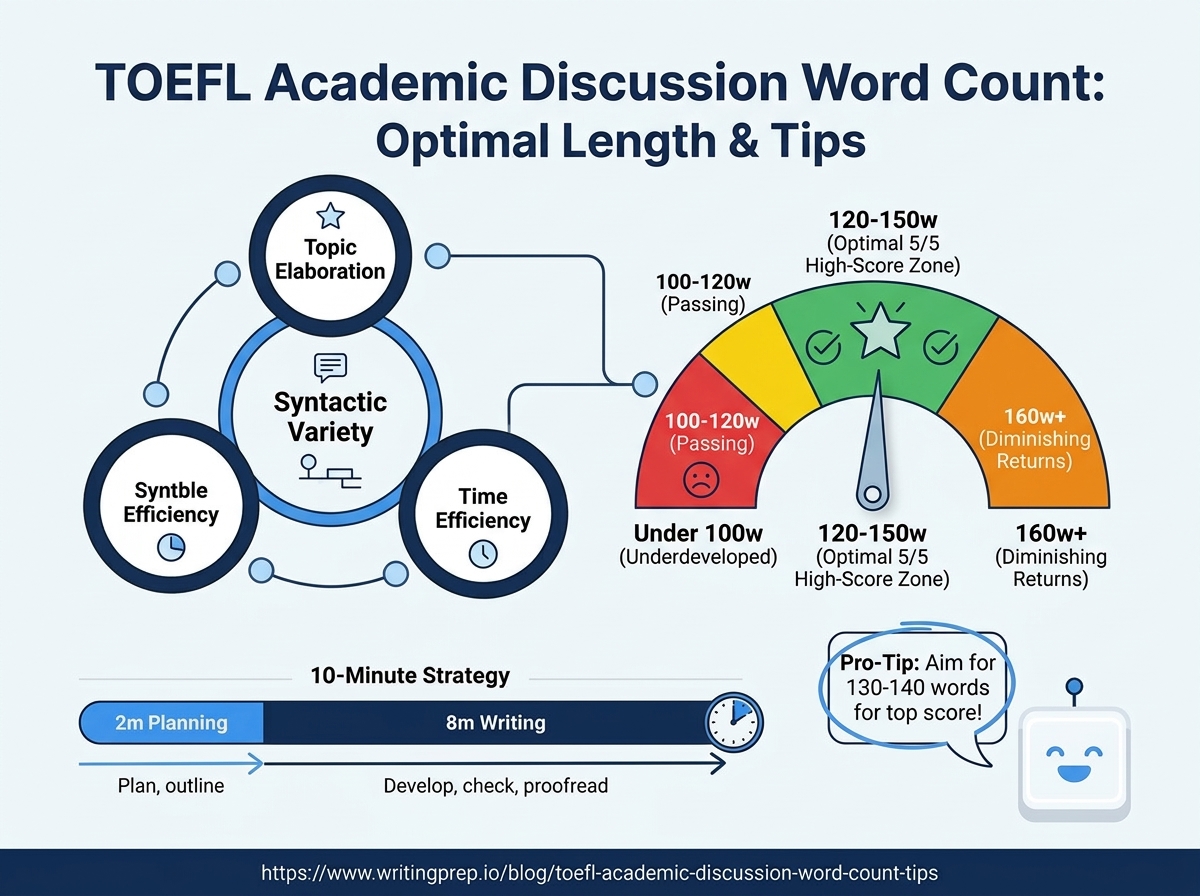
Empirical score data reveals the actual correlation between word count and raw rubric scores:
┌─────────────────┬───────────────────┬──────────────────────────────────┐
│ Word Count Zone │ Score Range (0-5) │ Diagnostic Evaluation            │
├─────────────────┼───────────────────┼──────────────────────────────────┤
│ Under 100 words │ 2.0 – 3.0         │ Underdeveloped / Sparse detail   │
│ 100 – 119 words │ 3.5 – 4.0         │ Adequate but lacks depth         │
│ 120 – 150 words │ 4.5 – 5.0 (Band 5)│ Optimal sweet spot for elaboration│
│ 165+ words      │ 3.5 – 4.5         │ Diminishing returns / Rush errors│
└─────────────────┴───────────────────┴──────────────────────────────────┘
The 4 Word Count Zones Analyzed
1. The Danger Zone: Under 100 Words
Writing fewer than 100 words exposes your essay to an immediate downgrade. Even if your grammar is pristine, an 85-word essay simply does not possess enough textual density to demonstrate compound-complex sentence variety or nuanced lexical deployment. Examiners categorize these as "limited development."
2. The Passing Zone: 100 to 119 Words
This zone satisfies the basic prompt requirement. You can attain a reliable Score 3 or 3.5 (scaled 20–23) if your grammar is clean. However, responses in this bracket rarely achieve a Score 5 because the supporting example is typically truncated to a single generic sentence.
3. The Golden Sweet Spot: 120 to 150 Words
This is the target zone for a 28–30 scaled score. At 125–145 words, you have ample room to execute a sophisticated peer attribution, articulate a nuanced reason, and illustrate it with a vivid 2-sentence micro-example without burning through your 10-minute clock.
4. The Diminishing Returns Zone: 165+ Words
More is not always better. In a 10-minute timed environment, typing 170+ words almost always leads to careless typographical errors, run-on sentences, and omitted commas. Furthermore, long essays frequently drift off-topic or repeat ideas needlessly. ETS awards no bonus points for word count inflation once full development is proven.
The 130-Word Golden Structure (Sentence-by-Sentence)
To consistently hit 120–150 words without agonizing over length, follow this reliable 5-sentence architecture:
[Sentence 1: Peer Attribution & Perspective] (~25 words)
      ↓
[Sentence 2: Core Argumentative Mechanism] (~25 words)
      ↓
[Sentence 3: Deepening Causal Explanation] (~25 words)
      ↓
[Sentence 4: Concrete Real-World Illustration] (~35 words)
      ↓
[Sentence 5: Impact Synthesis / Concluding Takeaway] (~20 words)
─────────────────────────────────────────────────────────────
Total Output: ~130 words | Time Required: 7 minutes
Breakdown of the 5 Sentences:
- Sentence 1 (Stance & Context): Bridge directly from one student's comment while setting up your distinct angle.
- Sentence 2 (The "Why"): Explain the fundamental mechanism driving your viewpoint.
- Sentence 3 (The "How"): Deepen the explanation by examining the systemic, psychological, or economic impact.
- Sentence 4 (The Proof): Anchor your claim in an authentic, concrete scenario or institutional case study.
- Sentence 5 (The Wrap): State the broader long-term implication in one crisp academic clause.
5 Essential Tips to Hit the Word Count Sweet Spot Fast
1. Eliminate Conversational Fluff
Opening phrases like "In my personal opinion, I really think that this topic is very interesting and important" waste 18 words on empty calories. Replace them with high-density academic openers:
- ❌ Weak: "In my opinion, I think that what Maria said about remote work is very correct." (16 words)
- ✅ Strong: "While I share Maria's endorsement of workplace flexibility, an overlooked advantage is..." (12 words)
2. Exploit Causal Subordinators to Add Organic Length
Rather than writing short, disjointed sentences ("Cars pollute the air. People should use buses. This helps the climate"), use subordinating conjunctions (whereas, inasmuch as, insofar as, consequently) to build compound-complex sentences that naturally expand your word count with academic rigor.
3. Deploy One Focused Example Rather Than Two Superficial Ones
Listing three different examples ("For example in Japan, also in Germany, and in Canada...") drains your time and creates a disjointed shopping list. Instead, develop one specific example with a context, an action, and an outcome. That single developed example will organically provide 30–40 high-value words.
4. Practice with a Word Counter Interface
During test preparation, write exclusively inside simulated testing environments that display an active word count. Train your eyes to recognize what 130 words looks like visually in a text box. When your counter hits 135 words at the 8-minute mark, stop generating new arguments and transition immediately to proofreading.
5. Never Sacrifice the Final 60 Seconds for Extra Sentences
Many candidates frantically type a sixth sentence with 30 seconds remaining, leaving half-finished thoughts or catastrophic subject-verb errors. A well-crafted, spotless 125-word essay will consistently outscore a sloppy, unchecked 155-word essay. Always reserve 60 to 90 seconds to review subject-verb agreement, plural endings, and article placements.
Model Sample Response with Word-Count Breakdown
Here is an authentic prompt analyzed for optimal word count:
Prompt: The university is debating whether to fund athletic sports facilities or upgrade laboratory computing resources. What is your stance?
136-Word Model Answer (Target: 120–150 words)
While I acknowledge David’s argument that recreational athletic complexes foster physical wellness and campus camaraderie, I strongly advocate for prioritizing cutting-edge computing laboratories. In today's data-driven academic landscape, computational literacy is the cornerstone of empirical research across both STEM disciplines and the humanities. When universities invest in high-performance computing clusters and advanced simulation software, students gain hands-on proficiency with tools directly demanded by modern research institutes and industry employers. For instance, recent graduates from institutions with modernized data facilities demonstrate substantially higher initial employment rates in competitive analytical sectors. Therefore, modernizing technological infrastructure represents a direct investment in academic productivity and professional readiness, yielding far more enduring institutional dividends than recreational amenities. (125 words)
Word Count Analysis:
- Stance & Attribution: 24 words
- Core Academic Argument: 24 words
- Operational Mechanism: 31 words
- Concrete Evidence: 23 words
- Synthesis & Takeaway: 23 words
- Total: 125 words — squarely in the high-score sweet spot with zero fluff.
Master Pacing and Word Count Live on WritingPrep
Knowing the target word count is easy; executing exactly 120–140 error-free words in 10 minutes under exam pressure requires deliberate, timed practice.
On WritingPrep, you can drill authentic academic discussion questions with real-time feedback:
- Live Word Count & Pace Tracker: Monitor your words-per-minute rate to ensure you reach the 120-word milestone by minute 7.
- Rubric-Aligned Scoring: Receive instant feedback evaluated against official ETS benchmarks for topic development, syntactic range, and lexical precision.
- Conciseness & Vocabulary Enhancements: Discover how to replace redundant phrasing with sophisticated academic vocabulary.
Experience the power of targeted writing practice. Start drilling your TOEFL skills on WritingPrep today!