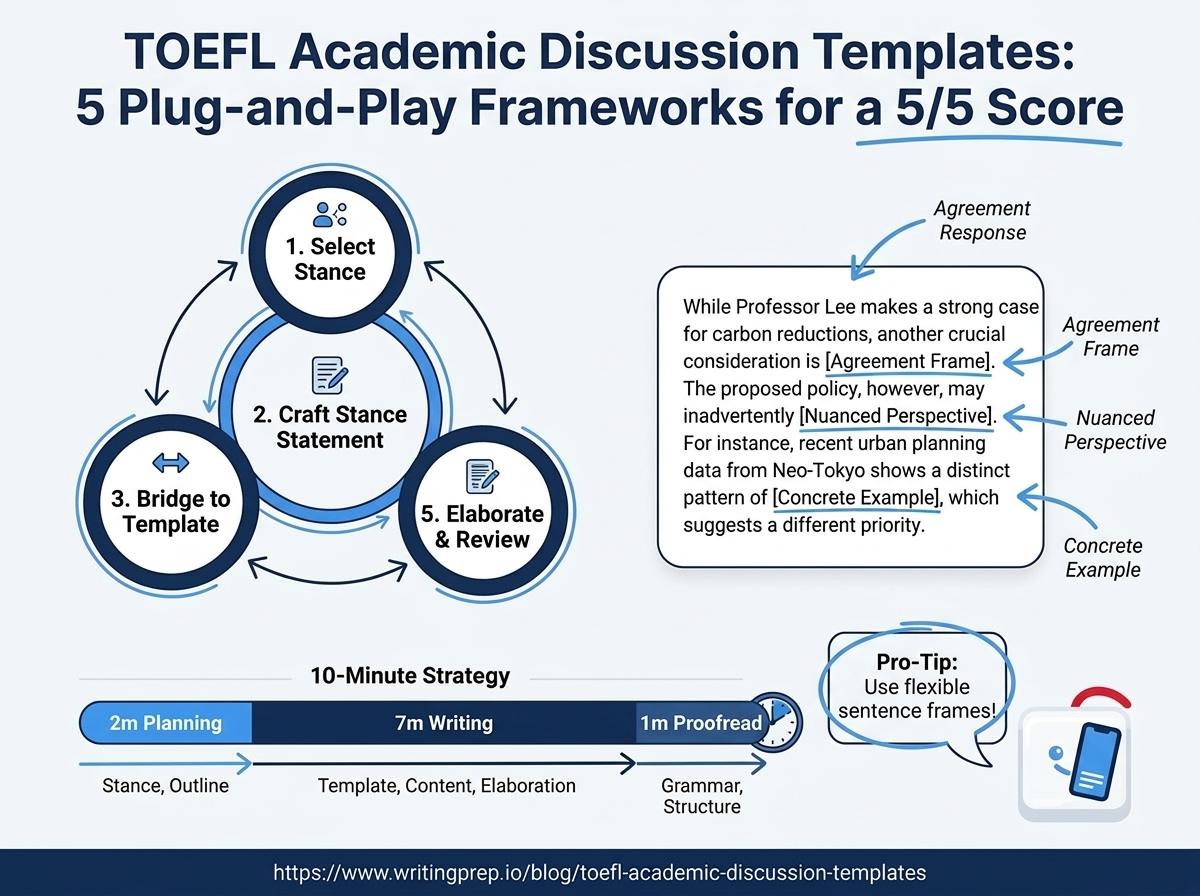
Why Memorizing Full Essays Fails in the 10-Minute Academic Discussion
The TOEFL iBT Writing for an Academic Discussion task gives you exactly 10 minutes to read a professor’s question, review two student responses, and write an impactful 100–150+ word academic contribution.
Many test-takers make the mistake of attempting to memorize rigid, generic essay templates used for traditional 30-minute independent essays. In a 10-minute online discussion board, however, formulaic filler sentences like "Since the dawn of human civilization, this topic has sparked fierce debate" instantly penalize your score. ETS raters and the automated scoring engine look for authentic conversational interaction, syntactic variety, and rapid elaboration.
Instead of memorizing entire essays, the secret to achieving a top score (4.5–5.0 / 30 scaled) is mastering modular sentence frameworks. These plug-and-play structures allow you to acknowledge peer ideas, pivot smoothly to your thesis, and substantiate your claim with zero hesitation under timed pressure.
If you are just beginning your preparation, review our foundational guide on TOEFL Academic Discussion Strategies and hone your timing on our dedicated TOEFL Writing Practice platform.
The Anatomy of a High-Scoring Academic Discussion Response
Before selecting a template, you must understand the 4 essential components every 5/5 response must deliver:
[Component 1: Direct Stance & Peer Attribution] (1-2 sentences)
         ↓
[Component 2: Core Rationalization / Mechanism] (2-3 sentences)
         ↓
[Component 3: Concrete Evidence or Micro-Scenario] (2-3 sentences)
         ↓
[Component 4: Concluding Synthesis / Broader Implication] (1 sentence)
- Clear Stance with Contextual Reference: Immediately clarify whether you lean towards Student A, Student B, or a fresh perspective without copying their exact words.
- Distinct Value Addition: Introduce an angle neither classmate mentioned (e.g., economic fallout, psychological well-being, technological feasibility, equity).
- Substantiated Explanation: Use because, specifically, or for instance to explain the real-world cause-and-effect.
- Syntactic Sophistication: Seamlessly integrate compound-complex sentences, participial phrases, and precise vocabulary.
Framework 1: The "Nuanced Agreement" Template
Use this framework when you agree with one of the classmates (e.g., Student A) but want to introduce an entirely new dimension or secondary benefit that they failed to mention.
The Plug-and-Play Structure
- Opening Pivot: While I concur with [Student A] that [summarize their general point], I believe an even more compelling dimension to consider is [your new angle].
- Elaboration: Specifically, when [condition occurs], individuals / institutions often [explain the mechanism]. This is particularly evident in [field / industry], where [further explanation].
- Concrete Example: For instance, [brief 1-2 sentence real-world illustration or typical scenario].
- Wrap-up: Therefore, although [Student A]'s focus on [their point] is legitimate, [your new angle] makes the case even more decisive.
5/5 Sample Response Using Framework 1 (Topic: Remote Work)
While I concur with Claire that remote working arrangements substantially boost individual convenience, I believe an even more compelling dimension to consider is the environmental and economic relief brought to urban infrastructure. Specifically, when daily commutes are curtailed, municipal transit systems experience reduced congestion, and vehicular emissions plummet dramatically. For instance, recent urban planning analyses during the post-pandemic transition revealed that hybrid work schedules lowered peak-hour smog levels in major metropolitan centers by nearly fifteen percent. Therefore, although Claire’s focus on flexible personal schedules is legitimate, the broader societal sustainability resulting from decentralized offices makes remote work an indispensable modern policy. (109 words)
Framework 2: The "Polite Counter-Perspective" Template
Use this framework when you disagree with a popular stance (e.g., Student B) or when the existing viewpoints overlook a major drawback.
The Plug-and-Play Structure
- Opening Pivot: Although [Student B] presents a persuasive argument regarding [their core idea], this perspective overlooks the significant downside of [your counter-point].
- Mechanism: In reality, prioritizing [Student B's proposal] frequently leads to [negative outcome], because [explain why].
- Illustration / Proof: Take, for example, [concrete case or professional context]. If [action happens], the resulting [consequence] inevitably outweighs the short-term gains.
- Synthesis: Consequently, rather than focusing solely on [Student B's idea], policymakers / leaders should prioritize [your alternative solution].
5/5 Sample Response Using Framework 2 (Topic: Government Electric Vehicle Subsidies)
Although Paul presents a persuasive argument regarding the necessity of direct subsidies for electric car buyers, this perspective overlooks the acute equity divide and infrastructural bottleneck of such policies. In reality, subsidizing private vehicle purchases primarily benefits affluent homeowners who possess private garages, while leaving low-income commuters without reliable transportation. Take, for example, dense urban centers where mass transit is severely underfunded; allocating tax revenue to subway modernization and electric bus fleets reduces congestion for hundreds of thousands daily rather than incentivizing a handful of private commuters. Consequently, rather than prioritizing private car rebates, municipal authorities should direct resources toward green public transit networks. (106 words)
Framework 3: The "Middle Ground & Synthesis" Template
Often, both student responses address extremes (e.g., "Ban smartphones entirely in schools" vs. "Allow unrestricted smartphone access"). This template positions you as an insightful academic thinker who synthesizes the best elements of both sides.
The Plug-and-Play Structure
- Opening Synthesis: Both [Student A] and [Student B] raise valid arguments regarding [general dilemma]; nevertheless, the most effective approach lies in a balanced strategy that [your balanced solution].
- Balancing Argument: On one hand, [Student A] is correct that [concede point A]; however, completely ignoring [Student B's concern] would inevitably [mention risk].
- Actionable Solution: By implementing [specific compromise or guideline], institutions can harness [benefit of A] while mitigating [risk of B].
- Example / Impact: A case in point is [academic or workplace policy example], which demonstrated that structured boundaries yield far superior outcomes than either extreme.
5/5 Sample Response Using Framework 3 (Topic: AI Tools in University Classrooms)
Both Sarah and Michael raise valid arguments regarding the integration of generative artificial intelligence into academic coursework; nevertheless, the most effective approach lies in a balanced framework that treats AI as a collaborative drafting assistant rather than a replacement for analytical inquiry. On one hand, Sarah is correct that unguided reliance on AI diminishes students' foundational writing skills; however, outright prohibition is both unenforceable and counterproductive in preparing graduates for modern industry. By implementing mandatory citation of AI prompts alongside oral defense of submitted arguments, universities can cultivate technical literacy while safeguarding cognitive rigor. As educational research demonstrates, structured coexistence with new technologies consistently yields better learning outcomes than outright resistance. (114 words)
Framework 4: The "Economic & Practical Feasibility" Template
Examiners love responses grounded in pragmatic reality. When other students debate moral or theoretical ideals, this template lets you anchor your answer in cost-effectiveness, scalability, and implementation.
The Plug-and-Play Structure
- Opening Pivot: While ideological debates surrounding [topic] are important, as [Student A] notes, the decisive factor must ultimately be economic and logistical feasibility.
- Economic Mechanism: From a practical standpoint, [policy or action] demands substantial upfront capital that [entity] simply cannot sustain without [consequence].
- Targeted Evidence: Consider the situation in [specific context or industry]: when funds are channeled toward [inefficient proposal], essential services such as [vital priority] suffer budget deficits.
- Conclusion: Thus, pragmatic resource allocation must supersede theoretical benefits when evaluating [topic].
Framework 5: The "Long-Term Ripple Effect" Template
When prompted about modern changes—such as automation, healthcare policies, or university curriculum shifts—this framework projects 5 to 10 years into the future.
The Plug-and-Play Structure
- Opening Projection: While the immediate advantages outlined by [Student A] are appealing, one must evaluate the cumulative, long-term repercussions of [action / trend].
- Future Forecast: Over an extended timeline, consistently [doing action] creates systemic shifts in [domain], eventually resulting in [broader implication].
- Comparative Contrast: Whereas short-term observers focus on [immediate metric], forward-looking analyses reveal that [long-term reality].
- Final Verdict: For this reason, long-range sustainability should serve as our primary evaluative benchmark.
High-Scoring Academic Sentence Starters Cheat Sheet
Keep these transitional phrases at the top of your mind during the 10-minute drill:
| Category | High-Scoring Sentence Starters |
|---|---|
| Acknowledging Classmates | • Building upon the insightful point raised by [Name]... • While [Name] makes a compelling case concerning... • Although [Name] accurately identifies the role of... |
| Pivoting to Your Angle | • ...an overlooked aspect of this discussion is... • ...this observation fails to account for the systemic impact of... • ...the primary catalyst remains... |
| Introducing Examples | • This phenomenon is vividly illustrated by... • A prominent case in point can be observed in... • Empirical evidence from modern organizations indicates that... |
| Cause & Effect | • Consequently, the ripple effects extend far beyond... • This dynamic inevitably precipitates... • By virtue of this development, individuals are empowered to... |
10-Minute Pacing Strategy: 2m Plan, 7m Write, 1m Proofread
Under strict test-day conditions, panic and misallocated time cause more point deductions than weak vocabulary. Follow this strict breakdown:
[00:00 - 02:00] READ & OUTLINE
• Read professor prompt and student posts (60 sec)
• Choose stance & identify your UNIQUE value-add (30 sec)
• Select Framework 1, 2, 3, 4, or 5 (30 sec)

[02:00 - 09:00] WRITE (Aim for 120-140 words)
• Sentence 1-2: Anchor peer name and state your clear stance
• Sentence 3-4: Explain the causal chain (why / how)
• Sentence 5-6: Provide concrete real-world context

[09:00 - 10:00] PROOFREAD
• Check subject-verb agreement (e.g., singular/plural)
• Check article usage (a/an/the)
• Check commas after introductory transitional clauses
Master Your 10-Minute Response on WritingPrep
Memorizing frameworks on paper is only half the battle. You need timed muscle memory so that typing, structuring, and academic vocabulary flow effortlessly.
On WritingPrep, you can drill authentic TOEFL Academic Discussion prompts under a simulated 10-minute countdown:
- Instant Rubric Evaluation: Receive a simulated 0–5 raw score and 0–30 scaled score in seconds.
- Grammar & Lexical Explanations: Detect subject-verb slips, run-on sentences, and repetitive vocabulary with actionable improvement advice.
- Topic Development Feedback: Our AI evaluates whether you truly contributed a unique perspective or merely restated classmate ideas.
Start practicing today on WritingPrep to turn these 5 frameworks into an effortless Band 5 score on test day!