Hey there, English learners! Navigating the world of English proficiency tests can feel a bit like trying to find your way through a maze. With options like the Duolingo English Test (DET), IELTS, and TOEFL, it's easy to get confused, especially when it comes to their writing sections. "Which one should I take?" "How different are they really?" These are common questions, and we're here to clear things up!
Understanding the nuances of each test's writing component is crucial for your preparation, whether you're aiming for university admission, a job, or even a scholarship. Let's dive into the core differences between the Duolingo English Test, IELTS, and TOEFL writing, and how you can boost your overall english writing skills for success.
What Each Test Looks For in Your Writing
While all these tests assess your English proficiency, they do so with different approaches and focuses.
The Duolingo English Test (DET) Writing Section
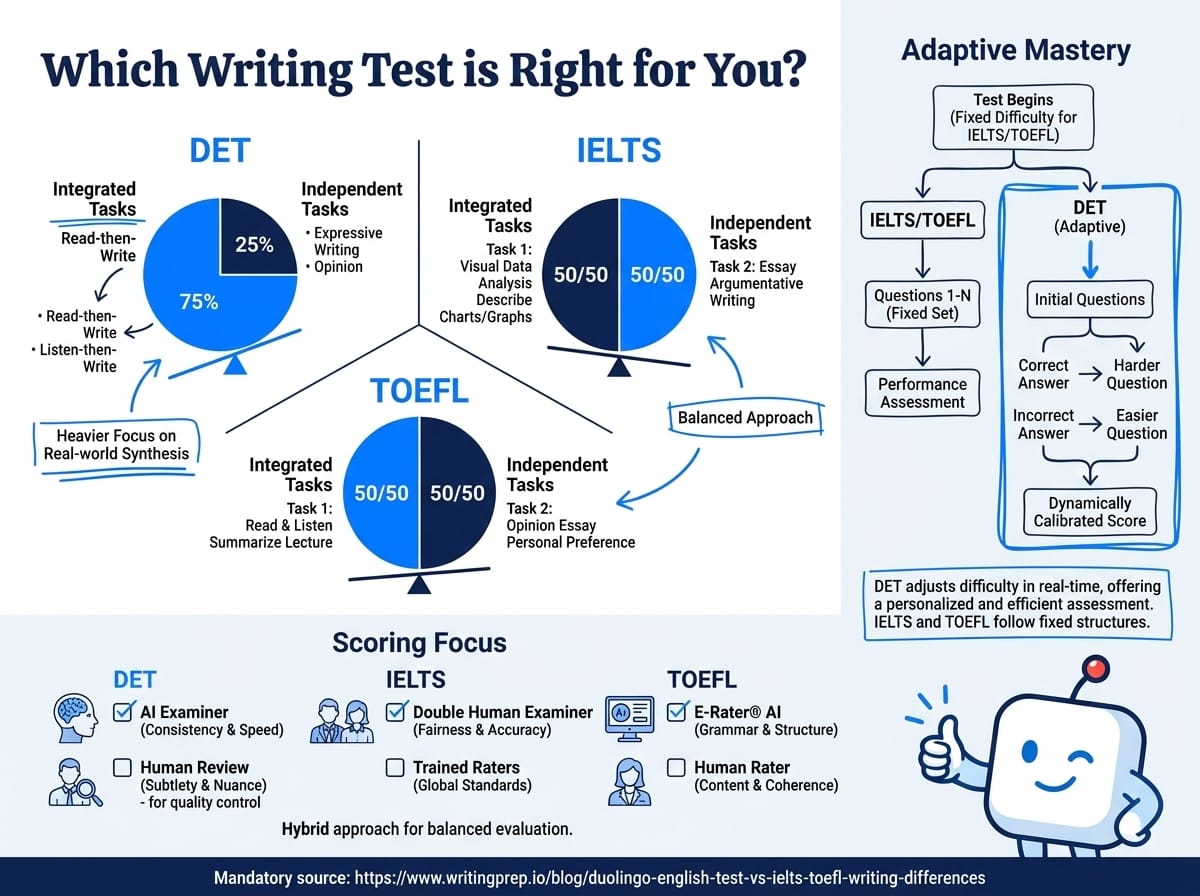
The Duolingo English Test (DET) is known for its adaptive, efficient, and technology-driven format. Its writing section reflects this, often featuring shorter, more varied tasks designed to assess your spontaneous written communication.
- Task Types: You'll encounter tasks like "Interactive Writing" (responding to prompts in a chat-like format), "Write about the photo" (describing an image), "Read, then Write" (responding to a written prompt), and "Summarize the spoken story" (listening and then writing a summary).
- Focus: The DET primarily looks for your ability to communicate clearly and fluently within time constraints. It assesses your vocabulary range, grammatical accuracy, and coherence in short bursts. While important, deep analytical skills or complex essay structures aren't the primary focus here.
IELTS and TOEFL Writing Sections
IELTS and TOEFL, on the other hand, are the traditional heavyweights, often required for academic institutions and professional registrations worldwide. Their writing sections are more structured, longer, and demand a higher level of academic rigor.
- IELTS Academic Writing: Consists of two tasks.
- Task 1: You'll describe, summarize, or explain visual information (graphs, charts, maps, processes) in at least 150 words. This tests your ability to select and report main features and make comparisons.
- Task 2: You'll write an essay of at least 250 words in response to a point of view, argument, or problem. This assesses your ability to present a well-developed argument, support it with examples, and use complex structures and vocabulary.
- TOEFL iBT Writing: Also has two tasks.
- Integrated Writing: You'll read a short passage, listen to a lecture on the same topic, and then summarize and explain the relationship between the two, typically showing how the lecture challenges or supports the reading.
- Independent Writing: You'll write an essay expressing and supporting your opinion on a given topic, similar to IELTS Task 2 but with its own scoring criteria.
- Focus: Both IELTS and TOEFL writing sections rigorously evaluate your grammatical range and accuracy, lexical resource (vocabulary), coherence and cohesion, and task achievement/response. They demand well-structured arguments, critical thinking, and the ability to use complex academic language effectively.
Key Differences Summarized
Here's a quick breakdown of the main distinctions:
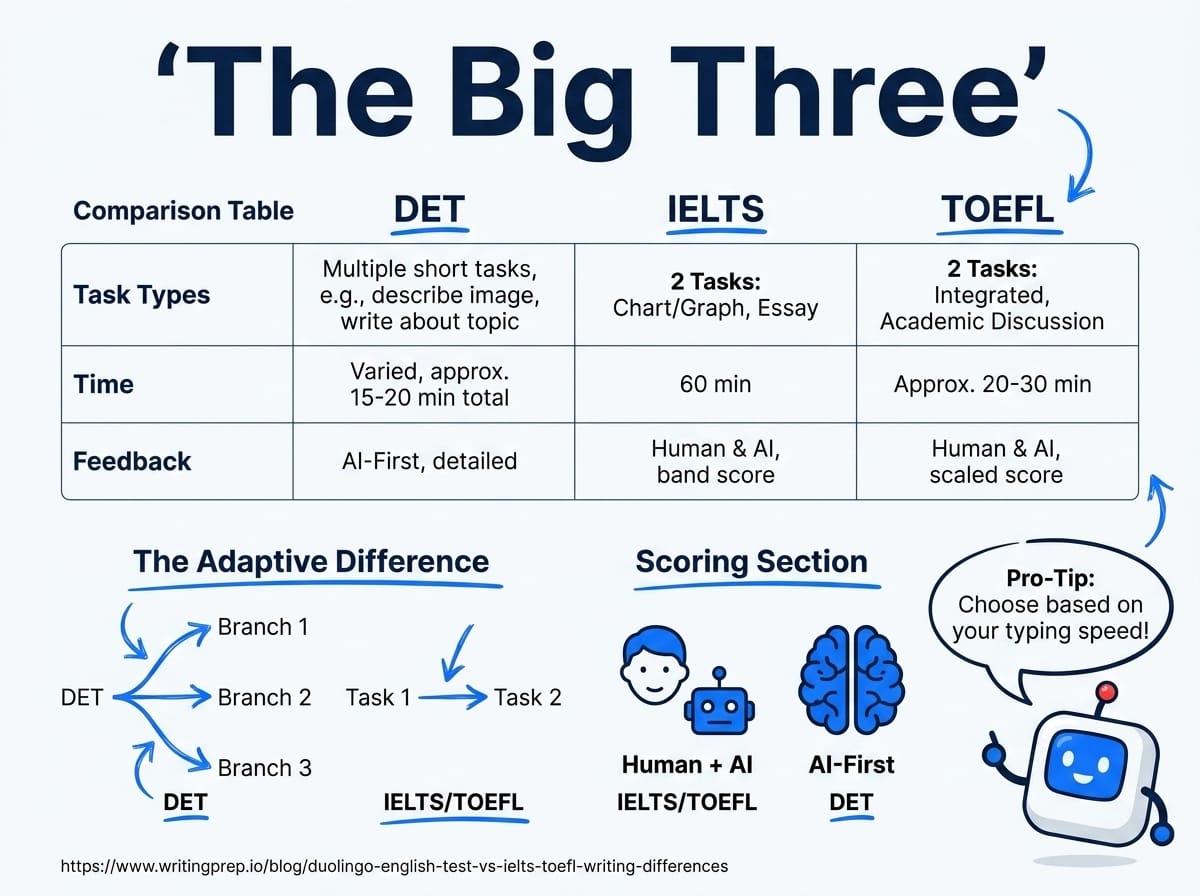
- Length & Structure: DET tasks are generally shorter and more varied, focusing on quick responses. IELTS/TOEFL require longer, more structured essays that demand sustained writing and detailed argumentation.
- Assessment Criteria: The Duolingo English Test emphasizes fluency, basic coherence, and vocabulary in spontaneous communication. IELTS/TOEFL prioritize academic writing conventions, complex grammar, advanced vocabulary, logical argumentation, and critical analysis.
- Purpose & Acceptance: While the DET is gaining wider acceptance, especially for undergraduate admissions or as a supplementary test, IELTS and TOEFL remain the gold standard for many universities, graduate programs, and scholarship applications globally. Always check the specific requirements of your target institution!
How to Prepare & Boost Your English Writing Skills
No matter which test you're preparing for, consistent practice is key. However, your approach should differ based on the test's demands.
General Tips for All Tests:
- Read Widely: Expose yourself to various texts to improve vocabulary and understanding of different writing styles.
- Master Grammar: A solid grasp of grammar is fundamental. Practice sentence structures, tenses, and punctuation.
- Expand Vocabulary: Don't just learn new words; learn how to use them accurately in context.
- Practice Regularly: The more you write, the better you'll become.
For DET Specific Preparation:
Focus on speed and accuracy in short responses. Practice describing images, summarizing short audio clips, and responding to chat prompts quickly. Build your ability to formulate immediate, coherent sentences.
For IELTS/TOEFL Specific Preparation:
Dedicate time to understanding essay structures (introductions, body paragraphs, conclusions). Practice developing strong arguments, supporting them with evidence, and using transition words effectively to ensure coherence. For IELTS Task 1, practice interpreting different types of data. For TOEFL Integrated Writing, practice synthesizing information from reading and listening. Time management is also crucial for these longer tasks.
Your Ultimate Writing Companion: WritingPrep
Feeling overwhelmed by the different requirements? This is where WritingPrep comes in as your personal AI-powered writing tutor!
Whether you're tackling the quick-fire tasks of the Duolingo English Test or the demanding essays of IELTS and TOEFL, WritingPrep offers personalized, immediate, and actionable feedback to elevate your english writing skills.
- Comprehensive Feedback: Get detailed evaluations on your grammar, vocabulary, coherence, clarity, and overall writing quality. WritingPrep doesn't just correct mistakes; it helps you understand how to improve.
- Targeted Practice: Practice specific essay types for IELTS and TOEFL, and receive feedback tailored to the test's scoring criteria. Our platform provides structured guidance to help you master academic writing.
- Revision Guidance: Learn to revise effectively with suggestions that guide you through making your writing stronger and clearer.
- Accessibility: High-quality writing support is now more accessible and affordable than ever.
Don't let the differences between tests hold you back. Understand them, prepare strategically, and let WritingPrep be your guide to achieving your desired scores and unlocking opportunities like that coveted scholarship or university admission.
Ready to take your writing to the next level? Start practicing now and experience the power of personalized feedback with WritingPrep!