Conquering TOEFL Academic Discussion Writing: Your High-Score Blueprint
The TOEFL iBT exam is a critical milestone for international students and professionals seeking admission to top global universities. Among its sections, the TOEFL Academic Discussion writing task presents a unique test: within just 10 minutes, you must articulate an academic perspective, synthesize classmate viewpoints, and write a concise, well-developed response of 100–150+ words.
Whether you are practicing with our TOEFL Writing Practice tool or comparing test formats in our IELTS vs. TOEFL Writing Comparison, this comprehensive guide equips you with top strategies, templates, and rubrics to conquer the Academic Discussion task.
Understanding the TOEFL Academic Discussion Task
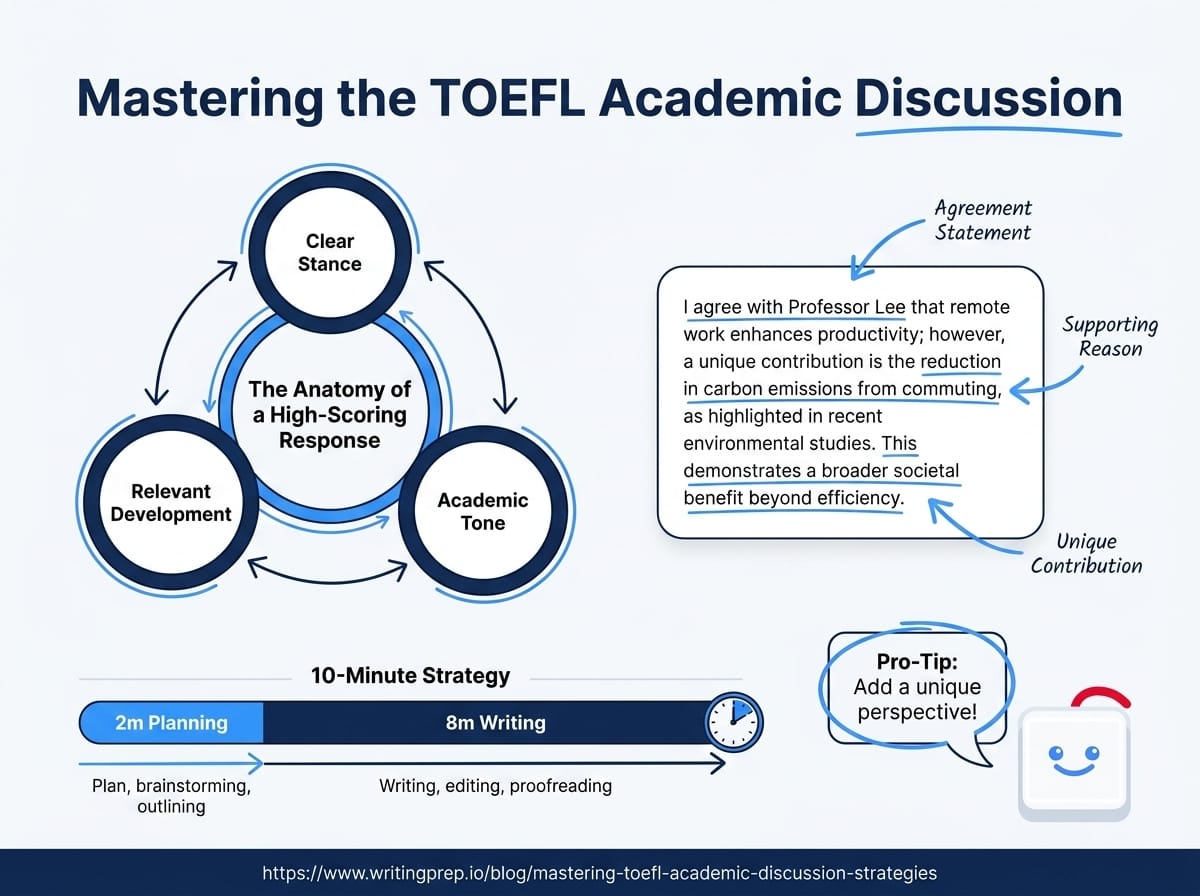
The Academic Discussion task requires you to read a short prompt from a professor, followed by two short responses from other students. Your task is to write your own response, expressing your opinion, contributing to the discussion, and demonstrating your ability to use academic English effectively. You need to:
- Clearly state your opinion or perspective.
- Support your ideas with relevant reasons, examples, or explanations.
- Reference or respond to the professor's prompt and/or the other students' comments.
- Maintain a formal, academic tone.
- Demonstrate strong grammar, vocabulary, and organizational skills.
This task is not just about writing; it's about demonstrating critical thinking and interactive communication in an academic context.
Top Strategies for Excelling in the Academic Discussion
Achieving a top score requires a strategic approach. Here are key tactics to implement:
1. Analyze the Prompt and Responses Thoroughly
Before you even think about writing, dedicate time to fully comprehend the professor's question and the two student responses.
- Identify the core issue: What is the central topic being discussed?
- Understand the professor's directive: What exactly are you being asked to do (e.g., share your opinion, agree/disagree, provide an example)?
- Grasp the students' viewpoints: What are their main arguments or examples? How do they relate to the central topic?
- Brainstorm your own ideas: Think about how you can contribute meaningfully to the conversation, either by introducing a new point or elaborating on an existing one.
2. Formulate a Clear and Coherent Stance
Your response should begin with a clear statement of your position or perspective. This acts as your thesis statement for the discussion. Avoid ambiguity; let the reader know where you stand from the outset.
3. Develop Your Arguments with Specificity
Once your stance is clear, support it with well-developed arguments.
- Provide specific examples: Abstract ideas are less convincing than concrete illustrations. Draw from your general knowledge, personal experience (if appropriate and academic), or hypothetical scenarios.
- Explain your reasoning: Don't just state an example; explain how it supports your point.
- Maintain logical flow: Use transition words and phrases to connect your ideas smoothly, ensuring your response is easy to follow.
4. Engage with Other Participants' Ideas
A crucial aspect of the TOEFL Writing Academic Discussion is demonstrating your ability to participate in a dialogue.
- Reference their points: You can agree with a student, respectfully disagree, or build upon their ideas. For example, "I agree with Maria that..." or "While David raises a valid point about..., I would also add that..."
- Add value: Don't just repeat what others have said. Bring a new perspective, an additional example, or a deeper analysis to the table.
5. Prioritize Grammar, Vocabulary, and Sentence Structure
Accuracy and sophistication in language are heavily weighted.
- Grammar: Ensure your sentences are grammatically correct. Pay attention to subject-verb agreement, verb tenses, article usage, and punctuation.
- Vocabulary: Use a range of academic vocabulary appropriate for the topic. Avoid repetition. This is where an online vocabulary evaluation tool can be incredibly helpful for identifying areas for improvement.
- Sentence Structure: Vary your sentence structures (simple, compound, complex) to make your writing more engaging and demonstrate advanced language proficiency.
How WritingPrep Elevates Your Academic Discussion Responses
This is where WritingPrep becomes an indispensable asset for mastering TOEFL writing. Our AI-powered platform provides the personalized feedback you need to refine your skills specifically for the Academic Discussion task.
- Instant, Detailed Feedback: Submit your practice responses and receive immediate, actionable feedback on grammar, vocabulary, coherence, clarity, and overall writing quality. No more waiting for a tutor or wondering where you went wrong.
- Grammar & Syntax Precision: WritingPrep identifies and explains grammatical errors, helping you understand why a correction is needed, not just what the correction is. This is vital for avoiding common pitfalls in academic writing.
- Advanced Online Vocabulary Evaluation: Our platform analyzes your word choice, suggesting more precise, varied, and academic synonyms. This dedicated online vocabulary evaluation helps you expand your lexicon and use words more effectively, crucial for demonstrating high-level proficiency.
- Coherence & Clarity Assessment: WritingPrep evaluates how well your ideas flow and if your arguments are easy to understand. It provides guidance on improving transitions and logical connections, which is key for a persuasive academic discussion.
- Targeted Practice for TOEFL: The platform can simulate the TOEFL Writing Academic Discussion environment, allowing you to practice under timed conditions and receive feedback tailored to the specific rubric requirements. This makes your practice highly efficient and effective.
Many users find that consistent practice with WritingPrep significantly boosts their confidence and scores. For a comprehensive look at how it can transform your writing, visit WritingPrep.
Practice Makes Perfect with WritingPrep
The key to success in the TOEFL Academic Discussion, like any skill, is consistent, targeted practice with effective feedback. WritingPrep provides a scalable and affordable solution, giving you access to high-quality writing support whenever you need it. By understanding your weaknesses and receiving clear guidance on how to turn them into strengths, you’ll be well on your way to a perfect score.
Don't leave your TOEFL score to chance. Empower your preparation with personalized AI feedback and elevate your academic writing skills.
Ready to transform your TOEFL writing? Start Practicing with WritingPrep today and experience the difference personalized AI feedback can make.