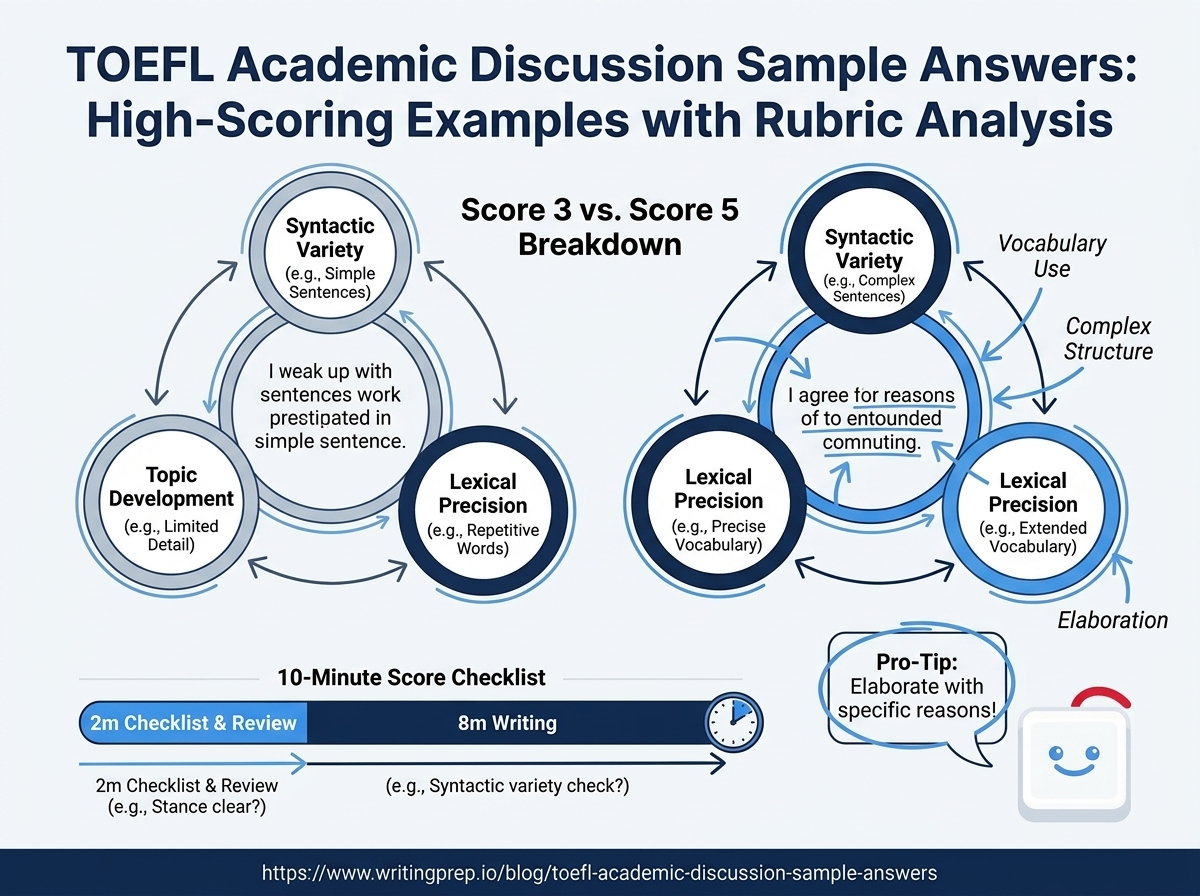
Understanding the ETS TOEFL Academic Discussion Scoring Criteria
In the TOEFL iBT Writing for an Academic Discussion task, your response is evaluated on a scale of 0 to 5 by both certified ETS human raters and the automated SpeechRater / e-rater engine. This raw score is subsequently scaled into the 0–30 section score alongside the Integrated Writing task.
To consistently score a 5 out of 5 (equivalent to 28–30 scaled points), it is not enough to write without spelling mistakes. You must understand the explicit benchmarks examiners evaluate:
┌─────────────────────────────────────────────────────────────────┐
│              ETS ACADEMIC DISCUSSION BENCHMARKS                 │
├───────────────────────────────┬─────────────────────────────────┤
│ 1. Relevant Elaboration       │ Contributes meaningful reasons, │
│                               │ specific details, or examples.  │
├───────────────────────────────┼─────────────────────────────────┤
│ 2. Syntactic Variety          │ Uses complex sentence forms,   │
│                               │ subordinate clauses, and flow.  │
├───────────────────────────────┼─────────────────────────────────┤
│ 3. Lexical Precision          │ Employs accurate, natural, and  │
│                               │ collegiate-level vocabulary.    │
├───────────────────────────────┼─────────────────────────────────┤
│ 4. Grammatical Facility       │ Minimal or negligible language  │
│                               │ errors that never obscure sense.│
└───────────────────────────────┴─────────────────────────────────┘
Below, we dissect three authentic academic discussion prompts, comparing real Score 3 (Mediocre) responses with Score 5 (Exemplary) model answers to illustrate exactly what transforms a good response into an outstanding one.
For actionable sentence starters to use in your responses, explore our companion guide on TOEFL Academic Discussion Templates and our comprehensive overview of TOEFL Academic Discussion Strategies.
Prompt 1: Healthcare and Preventative Medicine Funding
The Professor's Prompt
Professor Henderson: In many countries, governments face tough decisions regarding where to direct public healthcare funds. Some argue that governments should invest heavily in preventative healthcare—such as public fitness campaigns, nutrition education, and early screening clinics. Others contend that the priority should be funding cutting-edge medical research and advanced hospital equipment to treat existing life-threatening diseases. What is your perspective?
Student Contributions
- Jessica: I firmly believe preventative care should receive the majority of funding. When people adopt healthier lifestyle habits, the overall incidence of heart disease and diabetes declines, which saves the government money in the long run.
- David: While prevention is beneficial, we cannot ignore patients who are currently suffering from acute illnesses like cancer or severe trauma. High-tech hospital equipment and innovative therapeutics save lives right now.
Comparison: Score 3 vs. Score 5
❌ The Score 3 Response (Needs Improvement)
I agree with Jessica that prevention is very important for people. If government spends money on gyms and healthy food, people will not get sick easily. David said that hospital equipment is needed for sick people, and that is also true, but prevention is better. In my country, many people have diabetes because they eat bad food. If they learn about nutrition, they can live better lives. Therefore, government should spend more on education and fitness because it is cheaper and good for everyone. (84 words)
Examiner Diagnostic Breakdown:
- Lack of Syntactic Variety: Relies on repetitive, simple sentences ("If government spends...", "David said that...", "In my country...").
- Superficial Repetition: Repeats Jessica’s points almost word-for-word without offering a fresh perspective or deeper mechanism.
- Underdeveloped Word Count: At 84 words, it misses the optimal 110–140 word zone needed to showcase collegiate vocabulary.
✅ The Score 5 Response (Exemplary)
While I appreciate David’s valid concern regarding patients currently requiring intensive medical intervention, I strongly side with Jessica in advocating for substantial preventative healthcare allocations. An often-overlooked factor is the disproportionate economic strain that chronic, preventable illnesses impose on public welfare systems. When municipal governments proactively subsidize community wellness centers and routine diagnostic screenings, they effectively mitigate the bottleneck in emergency hospital wards. For instance, several Scandinavian nations that decentralized preventative health clinics witnessed a marked reduction in emergency cardiovascular admissions over a five-year period. This preventive framework not only alleviates the workload of healthcare professionals but also preserves vital capital that can subsequently be reinvested into specialized research for incurable ailments. Ultimately, prevention provides the foundation for sustainable national healthcare. (127 words)
Why This Scores a 5/5:
- Diplomatic Engagement: Acknowledges David’s concern with sophisticated phrasing ("valid concern regarding patients currently requiring intensive medical intervention") before pivoting decisively.
- Fresh, High-Value Perspective: Introduces the specific mechanism of hospital bottleneck mitigation and Scandinavian empirical outcomes.
- Collegiate Lexicon: Natural usage of advanced academic vocabulary (mitigate the bottleneck, disproportionate economic strain, cardiovascular admissions, decentralized preventative health clinics).
Prompt 2: Urban Planning — Public Transit vs. Highway Expansion
The Professor's Prompt
Professor Diaz: Urban centers around the world are grappling with severe traffic congestion and population growth. City officials must decide whether to allocate transport budgets toward expanding public transit networks—like subways, light rail, and bus rapid transit—or expanding major highways to accommodate commuter vehicles. Which strategy represents the smarter long-term investment for a modern city?
Student Contributions
- Liam: Expanding highways is clearly the most practical solution. Most suburban families rely on personal automobiles for flexibility, and wider lanes reduce traffic jams during rush hour.
- Elena: Public transit is far superior. Adding more highway lanes simply induces more traffic, while investing in clean electric trains provides an environmentally sustainable alternative that serves all socio-economic groups.
Comparison: Score 3 vs. Score 5
❌ The Score 3 Response (Needs Improvement)
I think Elena is right because public transit is better for the environment than highways. When cities build more roads, more people buy cars and drive on them, which causes more pollution. In addition, cars are very expensive for poor people, so trains and buses are fairer. Liam thinks that highways give flexibility, but traffic is still terrible even on big highways. So the government must put money in public trains and buses to solve global warming. (79 words)
Examiner Diagnostic Breakdown:
- Basic Vocabulary: Relies on elementary adjectives (better, big, terrible, poor, fair).
- Vague Statements: Mentions "traffic is still terrible" without academic framing or specific causal progression.
- Abrupt Transitions: Overuses mechanical linkers (In addition, So) without organic cohesion.
✅ The Score 5 Response (Exemplary)
Elena’s assessment accurately identifies the phenomenon of induced demand; however, I would expand this debate by examining the socio-spatial accessibility that public transit provides to metropolitan economies. While Liam highlights commuter flexibility, expanding highway arteries inevitably exacerbates urban sprawl and segregates low-income workforces who cannot shoulder the prohibitive expenses of vehicle ownership and fuel. By contrast, a high-density, interconnected rail system integrates peripheral neighborhoods directly into commercial city centers, generating robust employment opportunities and equitable mobility. For example, Tokyo’s metropolitan rail network enables millions of diverse residents to commute seamlessly without automotive dependency, fostering vibrant, walkable districts. Consequently, investing in public transit is not merely an environmental palliative, but a catalytic investment in economic mobility and sustainable urban architecture. (124 words)
Why This Scores a 5/5:
- High-Level Subject Mastery: Cites the concept of induced demand and socio-spatial accessibility.
- Structural Cohesion: Connects economic mobility to transportation infrastructure logically.
- Varied Syntax: Seamlessly combines semi-colons, participle clauses (fostering vibrant, walkable districts), and contrastive subordinations (While Liam highlights...).
Prompt 3: Artificial Intelligence in Professional Journalism
The Professor's Prompt
Professor Albright: Generative artificial intelligence is increasingly being adopted by news media organizations to draft financial summaries, sports recaps, and breaking news updates. Some editors praise AI for its ability to produce rapid, cost-effective reporting, while others worry that automated content degrades journalistic integrity, nuances, and human accountability. How do you view the role of AI in contemporary journalism?
Student Contributions
- Sophia: AI is a tremendous asset for journalists. By automating repetitive data-driven tasks, reporters can dedicate their energy to in-depth investigative investigations that uncover systemic corruption.
- Thomas: Relying on AI in journalism is extremely hazardous. Algorithms inherit biases from training data and frequently hallucinate inaccurate facts, which completely erodes the public’s already fragile trust in news organizations.
Score 5 Model Response Breakdown
✅ The Score 5 Response (Exemplary)
Both Sophia and Thomas identify critical realities regarding the disruption of news media; nevertheless, I argue that the most prudent path is a hybrid editorial framework where artificial intelligence operates strictly under rigorous human oversight. While Thomas rightly emphasizes the existential danger of algorithmic hallucination and unchecked bias, Sophia is equally astute that reporters are currently overwhelmed by mechanical reporting obligations. By establishing mandatory human verification protocols for any machine-generated data, media organizations can expedite timely reporting without compromising fact-checking standards. A case in point can be observed in financial wire services like Bloomberg, where automated systems parse quarterly earnings reports while veteran correspondents verify interpretive conclusions. When deployed as an analytical assistant rather than an autonomous author, AI reinforces journalistic productivity while safeguarding public integrity. (132 words)
Anatomy of the Band 5 Execution:
- The "Middle Ground" Stance: Synthesizes Sophia's and Thomas's opposing viewpoints into a unified, mature recommendation.
- Industry Evidence: Cites financial wire services (Bloomberg) as a concrete, highly believable precedent.
- Concluding Punchline: When deployed as an analytical assistant rather than an autonomous author... provides an authoritative academic sign-off.
What Separates a Score 3 from a Score 5: Quick Reference
| Feature | Score 3 (Band 20–22 scaled) | Score 5 (Band 28–30 scaled) |
|---|---|---|
| Peer Integration | Copies classmate phrasing directly | Paraphrases with academic nuance |
| New Contribution | Restates known points with generic statements | Introduces a fresh perspective, data point, or mechanism |
| Sentence Structure | Repetitive simple/compound sentences | Fluid compound-complex structures, participial phrases |
| Vocabulary Level | Everyday conversational vocabulary (bad, good, expensive) | Collegiate vocabulary (exacerbate, mitigate, induced demand) |
| Word Count | Under 100 words (often 75–90 words) | 120–150 words fully developed |
Test Your Score Against Official Rubrics on WritingPrep
Under exam pressure, self-evaluating your own essays against the 4 ETS rubric dimensions is nearly impossible.
On WritingPrep, you can write responses to dozens of authentic TOEFL Academic Discussion prompts and receive immediate diagnostic evaluation:
- Instant Simulated Scoring: See your estimated 0–5 raw score and 0–30 scaled score in seconds.
- ETS Rubric Breakdown: Inspect your ratings for Syntactic Variety, Lexical Resource, and Topic Elaboration.
- Grammar & Collocation Guidance: Understand specific phrasing errors and discover natural academic alternatives.
Practice with the same rubrics ETS examiners use. Start drilling your TOEFL writing on WritingPrep today!